


Philip Mahoney, Accor’s newly appointed VP for F&B in India, the Middle East, Africa and Turkey is cool as a cucumber about his latest responsibilities on his plate. He has just the plan to bring home the bacon for the 422 hotels (92,104 keys) across these countries with another 217 properties (50,063 keys) in the pipeline.
Using food idioms comes naturally while talking about Mahoney; after all, he will cook up ways to make food and drink the heart and soul of each Accor hotel in the region. Fortunately, for him, the company’s rapid diversification of revenue streams and creation of nimble cost structures was well in place before he came on board. Mahoney plans to continue this approach and learn from it in terms of having a diverse, hospitality-based business, rather than a hotel-focused one.
F&B played a crucial role for Accor during the pandemic, which leveraged several tactics like off-site catering and home delivery. As things start to open up, Mahoney explained how hoteliers are still heavily reliant on domestic travellers in India. F&B offerings, thus, is even more important as they reach out to customers, understand how their needs have changed and offer variations that will grow our revenue. He also stated that introductions like digital menus, single-use recycled menus, more table service than buffet service and the continuation of home delivery and prepare-at-home restaurant meals are likely to retain guest favour long into the future.
How do you plan to drive Accor’s business strategy in India, using F&B offerings and destinations as the lynchpin?
Our F&B strategy rests on three pillars – living our brand promises for our guests; cultivating the talent of our colleagues; and creating added value for our owners. These are very much in tune with, and support, Accor’s strategy of making food and drink the heart and soul of our hotels, which is just as applicable in India as in other areas.
We have identified some key F&B specialists in each country. The team in India, led by Supreet Roy, General Manager of Novotel Chennai Chamiers Road, is raring to deliver great experiences for our guests in the restaurant, bar and events space while also delivering value for our owners. The team reports to Puneet Dhawan, Senior VP-Operations India and South Asia, so we make sure that F&B is totally aligned with the wider business strategy.

How will you revisit some existing F&B practices like rehauling menus or renovating dining and event spaces to keep pace with evolved market needs?
We already have updates planned and are developing market-specific concepts, which will draw on recent learnings and embrace contemporary design. We also have more than 20 hotels under development, including some which will add to Raffles and Fairmont’s presence in India.
The new hotels will obviously take a step forward and we are shaping some lovely new venues in them that will be great for the market. We already have some wonderful venues in India, of course, and amazing culinary skills on show. So, we will be tapping into that knowledge base to grow excellence for our new markets and extend brands.
The F&B team in India is already stretching themselves to have even better offerings and Supreet Roy has connected all our hotels so that they start to share ideas and co-create so we expect to see some real traction here.
What about hyper localisation of menu offerings?
This is an interesting one for us because it helps tackle two massive challenges: carbon footprint reduction and food waste reduction. It is one of our key messages and, again we are seeing some real progress.
Hotels are setting up partnerships with local farmers for specialised and organic produce. Additionally, they are establishing micro-farms either through traditional methods, where they have availability of land or through vertical hydroponic farming where they don’t.
We want to be ‘against throwayism’, which ties in nicely with our push towards more plant-based menus. In this, of course, we can learn a great deal from the Indian culinary – professional and domestic – scene.
How will these changes adhere to Accor’s Planet 21 commitments?
Everything we do is put through the filter of our sustainability programme and, broadly, if it doesn’t go through that lens, we won’t do it. Of course, we face big challenges here. Construction is the biggest and my colleagues are doing great things to work with developers in partnership to lessen environmental impact.
Operationally we are embarking on a range of initiatives to help this: food waste reduction, the elimination of single-use plastic and promoting conscious consumption. The latter we can do directly with messaging and menu choice but also indirectly through menu positioning, pricing nudges and the use of scent.
Opening new F&B outlets currently is daunting considering ad hoc restrictions, customer inclination for takeaway orders, rising food costs and manpower issues. How will you overcome these hurdles in India?
We aim to be diverse in our offering and responsive to the markets. Our teams are very savvy these days at getting into the Big Data to see what our target personas’ preferences are and that nimble approach to business has become very much the norm in the restaurant and bar business.
We have already invested in a new-start delivery service operating in GCC countries, partnering with our hotels, and see no reason why that can’t expand further afield. Meantime, we’ll continue to foster the partnerships that have been built up by hotels before and during the pandemic.
On the cost side of things, ‘against throwayism’ really helps with food costs so that’s a big push, not just because of cost, but because it’s the right thing to do and we all know that. Similarly, plant-based menus and hyperlocal will help offset food inflation.
As you say, the cost and availability of labour are increasing and we have to manage that but we would like to take positive action in that respect. Firstly, we want to increase productivity by enhancing the skill levels of our people, making them more efficient, feel better about themselves and make more tips! Secondly, we want to focus on the revenue rather than the cost: we can absorb additional costs by empowering and helping our people sell more either through just unleashing the younger generation’s natural desire to be storytellers, broadcasters or influencers – “listen to me, I’m going to give you some great choices that you’re going to love!”.
We need to help our leadership teams understand this mindset. It is no longer about following instructions and detailed SOPs, it is about giving a few guidelines, pulling the cord and letting them fly.
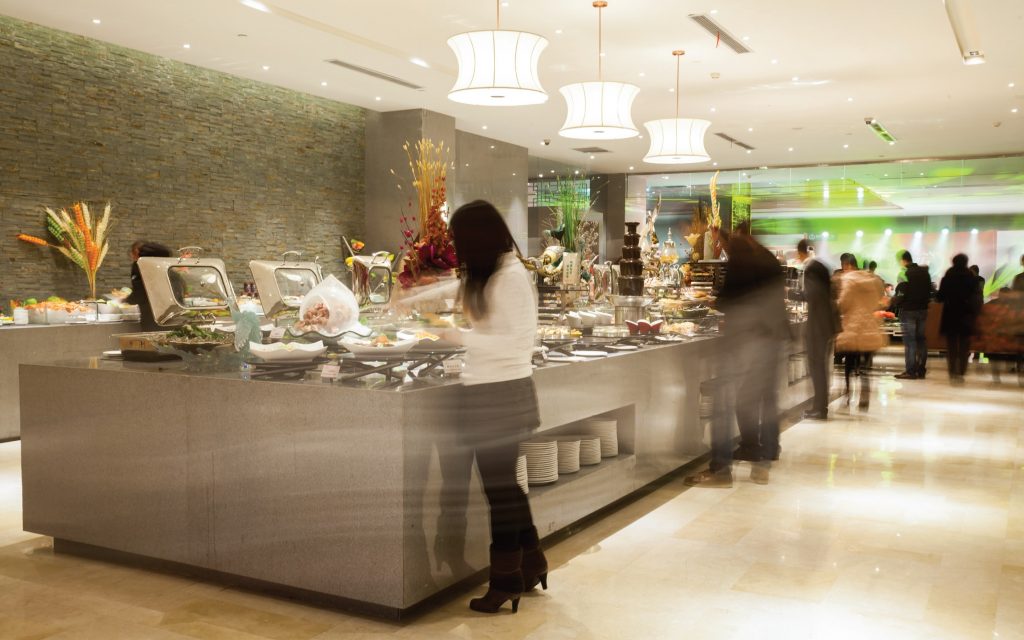
Lastly, we have to look at production as well as service: it’s contentious. But I think the days of the massive buffet are limited – what is billed as labour-efficient in service, is labour-intensive at the production end and there’s more waste.
Since food costs are going up, how will you approach the F&B business to ensure that costs at these outlets are lowered and profits are increased to turn all inventory into valuable sales dollars?
We already have a tidal wave of storytellers coming through the ranks so we must harness this. This dynamic, ultra-fast messaging comes as second nature to the younger generations and this is already adding value to people who want to see beautiful things, spaces and people, and become associated with them.
Then we can be cute in our menu optimisation approach: we can nudge people in the direction of certain choices (not against their will but just opening up options to them), we can make sure trade-ups exist where people want them, we can bundle items and we can promote sharing, where the check usually goes up. The rest we’re going to keep to ourselves just know.
The current crop of customers is seeking existential authenticity while dining out. What tech solutions will you use to create experience-driven F&B destinations in India without adding to your operational cost?
I am not convinced that high-tech solutions necessarily give people a better experience and I think we will take a view on it on a piecemeal basis. Digital menus, for instance, are great for some people but not others and we have to be mindful of that.
Self-ordering can be quirky but, in our world, it’s a burden on our guests too. I think it is great to see the progress of your meal when you are waiting on a delivery and we do that and can extend it to beach and pool service but, in a restaurant, wouldn’t you rather just talk to your waiter.
One of the best technology advances is about customer behaviour and preferences and we would like to harness that because it’s good for our guests. If we can recognise them through mobile geo-location or even face recognition, we can serve them better with a more tailor-made approach.
I’m guessing you are not sold on robotics, then?
We’re obviously starting to see robotics but I think we’re a long way off the front of house service acceptance in all but the most niche of venues. I see it as a massive opportunity back of the house and that will lead to greater consistency and speed which will benefit the customer in terms of product and pricing but we are not there yet. But I’m very excited about it.
I do believe we will always be a people business. It’s hospitality and we are humans, we love to interact but the more we can embrace technology to make the creation and the curation process quicker and easier for our talent, the better.
Should hotel companies consider leasing their F&B spaces to standalone marquee restaurant brands on a revenue-share model?
I think it is always important to think about what makes the most sense for a certain venue, in a hotel, in a certain marketplace. There can be a good case for leasing a venue, for instance, if the operator or their brand adds value to the overall product either as a destination hotel or a destination dining complex.
It may be that the rental opportunity is attractive and, that’s not to say that the hotel operator throws in the towel, just that it allows them to focus on other things be it other F&B venues or other core parts of the business. There’s no right or wrong answer, it’s what makes sense in a particular environment.


