
The real estate landscape in India is evolving, and one of the most exciting trends taking centre stage is the rise of branded residences.
Imagine living in a luxurious space backed by some of the world’s top hospitality brands. It’s no longer just about owning property; it’s about investing in an unparalleled lifestyle experience. As five-star hotels extend their brand into residential offerings, discerning buyers find themselves drawn to this blend of comfort and luxury.
What makes branded residences so appealing? And what are the challenges that lie ahead for this growing segment? Let’s dive deeper into this fascinating trend that is reshaping India’s real estate market.
What are branded residences?
Let’s start with understanding what branded residences are all about? The ‘Landscape of Branded Residences Report’ by NOESIS Capital Advisors, defines a branded residence as a typically mixed-use project that builds residential apartments in conjunction with a traditional hotel. The entire project (hotel and residence included) is then branded and managed by a company, often a hotel operator. Each branded residence unit is designed with a residential layout, with consideration for a kitchen, ensuite and/ or shared bathroom spaces, living spaces and additional areas conditional on typographies and the category of project. The luxury status attributed to these projects implies lavishly designed units, with state-of-art fittings, offering an elevated living experience compared to unbranded counterparts.
The origin of branded residences in India
According to a report titled ‘The Rise of Branded Residences in Asia Pacific’ by JLL, India’s thriving economy has boosted all real estate asset classes, particularly luxury residential developments in top-tier cities like Delhi, Mumbai, Bengaluru, Hyderabad, and Chennai. Increased demand for high-end residences, following the pandemic, led to higher prices and the expansion of branded residential developments.
Reportedly, Four Seasons and The Leela introduced India’s first branded residences in Mumbai and Bengaluru in 2015. This sparked increased demand as buyers started appreciating the value of premium branding and services that reflect their lifestyle preferences and offer developers higher returns. Previously, branded residences were typically linked to hotels, providing residents with premium services and developers with improved cash flow. However, key metro markets and leisure destinations like Goa and Jaipur are now witnessing growing interest in branded residences, with or without hotels.
Types of branded residences
Historically, branded residences comprised hotel-driven projects, wherein a segment of the property was dedicated to residential units for sale, integrated with the hotel amenities and carrying the hotel’s brand.
As per the NOESIS report, departing from the traditional branded residence model, diversified iterations have risen across the world to suit demand in varying markets and locations. One type would be standalone residences, just the branded residence without the adjoined hotel. Non-hotel brands such as Trump Towers (Mumbai, Pune, Delhi and Kolkata) have projects aligning with this typology. Another type would be a branded residential development with a hotel that is adjacent such as Three Sixty West (Mumbai).

Hotel-led developments with integrated residences typically include the lower floors being run as a hotel whereas the upper floors will occupy the residential units for example Four Seasons (Mumbai).
Trend of branded residences
The branded residences’ market in India is witnessing significant growth due to several key factors. Nandivardhan Jain, CEO of NOESIS Capital Advisors, explains, “Branded residences, a unique offering, offer a compelling opportunity by merging the expertise of established hospitality brands with the construction prowess of leading developers. They serve as a strategic win-win for both parties, promising high returns on investment and a luxurious living experience for the buyers.

“The allure of brand prestige and reputation, coupled with the management expertise of renowned hotel and non-hotel brands, ensures a high standard of living and service quality that is highly desirable among HNI (High Net Worth) consumers. Unique designs and lifestyles that align with global standards, along with the flexibility of high-end amenities tailored to residents’ needs, further enhance the appeal of these residences.”
Jaideep Dang, Managing Director, Hotels and Hospitality Group, India, JLL, says that over the past decades, branded residences have become a highly profitable and desirable development opportunity, globally and in Asia Pacific, in particular. “While for Indian investors, residential real estate has long been viewed as a reliable and crucial investment, the brand proposition is now the value-add,” says he.
Dang adds that in 2015, Four Seasons launched India’s inaugural branded residences in Mumbai and Bengaluru. This debut ignited growing demand as buyers recognized the value of premium branding and services that align with their lifestyle preferences while providing developers with higher returns. Particularly in the wake of the pandemic, the surge in demand for luxury residences further drove up prices and enabled careful growth of branded residential projects across India. Their emergence has combined India’s most favoured asset class with top-tier hospitality, thereby bolstering investor confidence in this market. This momentum is increasing over last couple of years and is evident in the newly announced signings.
Though still in its early stages, there is noticeable developer interest in cities such as Bangalore, Ahmedabad, Trivandrum, Goa, and Chennai.

The India Story
Talking about India’s oldest hospitality company IHCL’S foray in the branded residences’ segment, Suma Venkatesh, Executive Vice President, IHCL (Indian Hotels Company Limited), says, “Mixed use developments with co-existence of commercial, retail, residential and luxury hotels is a growing format in the real estate segment in metro cities. IHCL has its presence in such projects like Taj The Trees in Mumbai and the recent signing of a Taj hotel along with Taj branded residences within the same development in Chennai. As part of our growth strategy, we will evaluate such opportunities with a sharp focus on the project’s design complimenting the aesthetics and ethos of the Taj brand including the approach to architecture, landscape, interiors and sustainability.”

The complex in Chennai spread over 3.5 acres is strategically located at Nelson Manickam road with close proximity to key business districts. This greenfield development once completed will comprise of a luxury hotel with 235 keys and 123 Taj branded residences. The hotel will have four restaurants and bar, and a selection of adaptable meeting spaces with outdoor areas ideal for hosting both business and social events. Guests will also be able to enjoy recreational facilities of a pool, fitness center and spa. The branded residences will enjoy Taj’s legendary service and access to the hotel’s facilities.

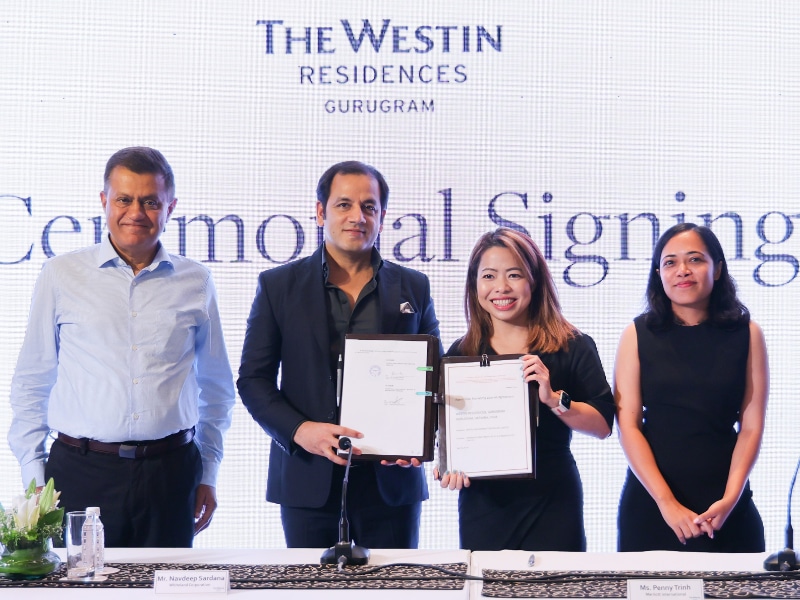
Giving us a peek into Marriott’s contribution to the growing segment, Penny Trinh, VP, Mixed Use Development, Asia-Pacific (excluding China), Marriott International, says, “In India, Marriott has two residential projects in the pipeline, including Westin Residences Gurugram, the largest Westin Residences in the world and a JW Marriott Residences in a tier 1 city. Prime urban locations such as the NCR region, Mumbai, Bengaluru, Hyderabad, and Chennai offer exciting growth opportunities. Additionally, we believe that leisure destinations located a short drive from metropolitan areas, such as Goa, Himachal Pradesh, and Udaipur, present ideal opportunities for second homes. These homes offer turnkey convenience, enabling homebuyers to move right into a fully furnished home.”

Incidentally, Marriott first entered the branded residential segment in 2000, with a Ritz-Carlton Residence in Washington, DC. “In those almost 25 years, we have seen the segment grow in many exciting and new ways, and we continue to be a leader and trailblazer in the segment. We have seen an increasing interest from people wanting to bring the comfort and service they know and love from their travels into their day-to-day lives, which is what Branded Residences can offer,” adds Trinh.
Harshavardhan Neotia, Chairman, Ambuja Neotia Group, finds the concept of branded residences rather interesting, and sees potential in this space. Says he, “We are exploring opportunities to integrate this model within our leisure home segment, particularly around our hospitality projects. Given the rising aspirations and demand for premium living spaces, branded residences could seamlessly blend luxury living with our refined hospitality services.”

Steep rise in two years
In the past two years, Dang says they have managed various projects across major cities, emerging markets and in vacation hotspots. “Our research shows that with the appropriate product combination, branded residences have the potential to thrive in multiple settings. In well-established metropolitan areas, standalone branded residential developments are likely to do well. Emerging markets, however, would benefit more from a combined hotel and residences model. Meanwhile, resort and branded villa developments would excel in prominent tourist destinations. The right blend of these elements is crucial for success. All this is happening due to the evolving demand from well informed, globally travelled discerning luxury homebuyers.”
Challenges in the segment
However, the rise of branded residences in India is not without its hurdles. One major challenge lies in the high investment required for development. Developers must ensure that they meet five-star hospitality standards while maintaining profitability.
Another issue is market saturation. As more luxury brands enter the sector, competition intensifies. This can lead to a dilution of brand value if not managed carefully.
States Dang, “Branded residences target the discerning clientele, delivering superior living standards that enhance lifestyle quality. Nonetheless, the long-term potential for rental income from these high-end properties, often priced above market averages, remains an open question.
“Moreover, residential properties typically transfer ownership titles, resulting in a complex owned by multiple stakeholders—primarily the homeowners who use its amenities. These developments are managed by Residential Welfare Associations (RWAs). Hence, it is essential to establish a transparent framework and define the scope of services between the brand and the RWAs to ensure effective and harmonious management. Adhering to this framework is crucial for the successful operation of branded residential properties.”
Legal and regulatory complexities also pose significant obstacles. “The Real Estate Regulation Act (RERA) will play an indispensable role in such agreements. Branded residences signify an emerging asset class from the luxury segment of the housing market. Today’s homebuyers are well-informed and globally savvy, which bodes well for the future of branded residential developments in India, positioning them for substantial growth in the coming years,” remarks he.
Future of this industry
The future, however, looks promising, with a growing demand for luxury living spaces. With 2,900 operational branded residence units (According to NOESIS Research) currently capturing close to 3% of the global market share, India presents a compelling opportunity for a diverse set of stakeholders to enter this market.
As urbanization accelerates, more people seek homes that offer both comfort and prestige.
Says Jain, “Looking ahead, the market is poised for continued growth, driven by increasing urbanization, rising disposable incomes and a growing preference for luxury living among affluent Indians. Market diversification with more non-hotel brands entering the segment and expansion into Tier 2 and Tier 3 cities are anticipated to broaden the scope and appeal of branded residences. In major cities like Mumbai, Delhi NCR, and Bengaluru, branded residences command a significant price premium over non-branded luxury residences, with Mumbai leading the market at INR 40,000 crore. Overall, the future of branded residences in India looks very promising, supported by evolving consumer preferences, economic factors and strategic market expansion.”

Dang concludes, “Historically, India’s housing market has been dominated by prominent real estate developers and reliable local and regional players. The recent introduction of branded residences, developed in partnership with hotel operators, represents a ground-breaking shift in the industry and is still awaiting full implementation. With India’s economic trajectory on the rise and homebuyers becoming increasingly sophisticated, we foresee a wave of these specialized projects, each customized to its specific locale and investors’ financial readiness.”