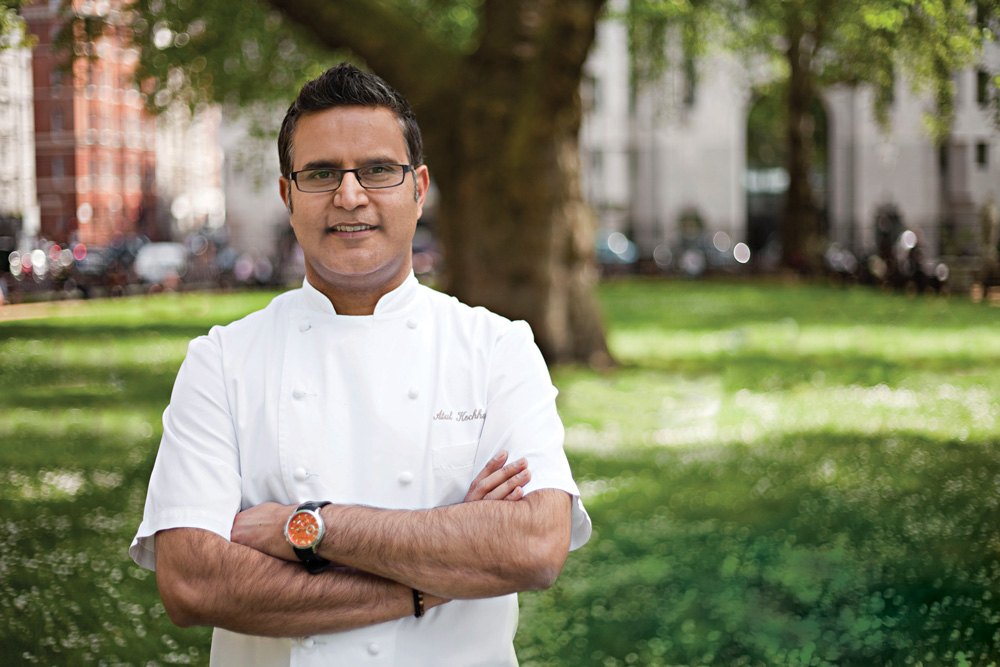
Chef Atul Kochhar has hardly a moment to spare these days. He is set to open Hawkyns, his first restaurant focused on British gastronomy at The Crown, Amersham in England. Here, traditional British fare will be given a makeover. Reinventing local cuisine comes naturally to Kochchar, who has been at the forefront of Indian fine-dining cuisine in the UK for years. Starting his career with The Oberoi Group in Delhi, in 1994 he opened the Tamarind restaurant, which achieved a Michelin Star in 2001, making him one of the first Indian chefs to receive the accolade. His progressive approach fused with love for traditional cooking techniques led him to open his own restaurant, Benares, in 2003, which won a Michelin Star in 2007. Since then, he has opened numerous award winning restaurants, including Sindhu at The Compleat Angler in Marlow and on board P&O cruises; Indian Essence in Petts Wood. Currently, Kochchar’s restaurant portfolio includes the second Benares in Madrid, Rang Mahal at the JW Marriott Marquis Hotel Dubai and NRI and Lima in Mumbai. To successfully manage high-end eateries across different countries, Kochchar knows it is imperative to put in place effective strategies so that each outlet offers the same level of service, quality and consistency that guests have come to expect from them. This is possible only by personal intervention. Hence, he oversees all concept and design plans and works closely with the team to ensure that standards are kept at a high always. “My quality assurance manager works with other staff to establish procedures and quality standards and to monitor these against agreed targets. It does mean that I travel a lot, interacting with our guests. However, I believe that listening and reacting
to feedback always gets results,” he explained. It is his belief that for a restaurant to prosper there must be a manager who can manage the staff efficiently and build a successful team, be it in the kitchen or on the restaurant floor. To him, it boils down to good training and hard work. “The best managers start their careers in the restaurant trade at the bottom rung and work their way up the ladder. They understand all aspects of the kitchen from pot wash to pantry to finance. My managers must respect the cooking team and ingredients used in my dishes. In turn, the team will respect them and work like a welloiled machine,” Kochchar clarified, adding why he always invests heavily in the top-notch people for each of his restaurants.
SOMETHING NEW, SOMETHING OLD
Often called the master of modern Indian cuisine, how does Kochchar manage to craft a menu that pays homage to Indian food and yet makes perfect sense without throwing the business economics out of the window? His formula is simple – know what your customers want and ensure that your restaurant delivers great tasting food, wonderful atmosphere, and generous service in a timely fashion. It is not about having singing or dancing waiters but more about focusing on seasonal local food and relaxing atmosphere and great customer service. It is also about staying relevant with changing guest expectations, and to do this, his teams must challenge themselves. “I like to change our menus with the seasons or monthly; this ensures we get the best produce the local region offers and it gives us an opportunity to keep the menu new and exciting,” he explained. He also encourages his team to form great working relationships with their suppliers who can provide them with the best produce, since it is origin for every menu change. “My chefs get to experiment with these ingredients and come up with dishes that they believe will be a hit with guests. Then the fun part happens where we all get to taste their creations,” Kochchar excitedly noted. And everyone in the restaurant is drawn into the menu redesign, from the floor managers to servers as they are the ones who interact with guests and can understand how they are likely to react to any change. Kochchar dons two hats now – of a chef and a businessperson. The only way he can do justice to both roles is by pre-planning and drawing a business plan as a roadmap for the future. “With the right planning, getting everything done in a timely manner can be accomplished with minimum frustration. Again working with seasonal ingredients allows us to pre-plan our menus, and also work around national holidays and celebrations as we know which will be our busier days, in terms of manpower budgeting,” he stated.
THE LEARNING NEVER STOPS
Till a few years ago, denizens in the UK had a perception about Indian cuisine – it was largely about spiceladen and oily curries. Kochchar decided to correct these misplaced presumptions by coupling Indian and British flavours to better adapt it to local tastes through subtle spicing. However, learning to strike this balance came after many years of trials and error. “When I first came to the UK, I used to cook in a traditional Indian manner. But then I realised that this is my home and I started absorbing influences around me — which includes British, Greek, Italian, German and other cuisines. I became savvy with ingredients grown in the UK — the spices, the types of vegetables, everything, and started using these in my cooking,” he revealed. Today, as a reputed chef, TV host and cookbook author, he knows that diners coming to his restaurant look forward to dishes that give a modern perspective to traditional Indian cuisine. He prefers to use classical flavours and spicing blended with regional and local ingredients to present food in a way that is more appealing to the local palates. For example, he pairs British New Forest Venison flavoured with Indian spices and pairs it with more traditional items like biryani so that it suits the local palate. He then decides which of these can be signature dishes or regular ones on the menu. Does this mean that all dishes are signature dishes? “Maybe. We are renowned for using different ingredients that you won’t find anywhere else, such as, our Duck with Mustard Sauce using mustard from Kolkata and the best seasonal duck available paired with Bengali- spiced kimchi,” Kochchar disclosed. There is no magic formula to getting the menu planning right though, as there have been times when he introduced dishes because it looked and tasted spectacular, but it had to be pulled out because the demand was not good. Talking about balancing his creative instincts with business judgment, Kochchar said at times like these he reworks the dish to find something more suitable, based on guest feedback to make it into something that ultimately sells. Kochchar himself likes to keep learning about local cuisines, and luckily for him, given the amount he travels he gets an opportunity to try and taste various kinds of fare. He dines out whenever he can and makes time to cook with other chefs who specialise in different cuisines. He also invites chefs to his restaurants for his Chef Season where he collaborates on a tasting menu, incorporating their mutual skills to offer something different to guests. Ask him about his inspiration and he says it is Mother Nature. “My team and I are the brushes, Mother Nature is the artist, food is the paint and our senses are the canvas,” he summed up enthusiastically.