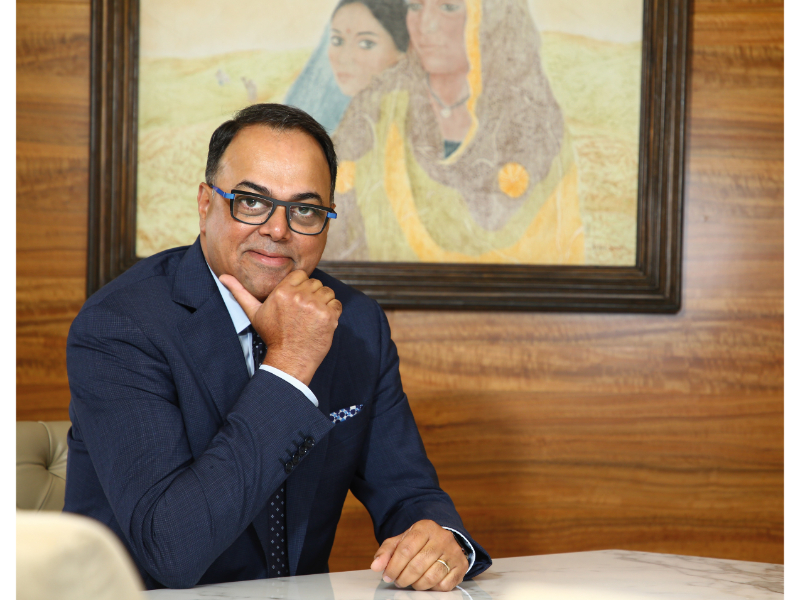
He wanted to be an Air Force pilot but ended up becoming a ‘Hospitality pilot’. Not just on Indian soil, but also on a global level. Meet Rajeev Menon, the man who’s steering the growth of Marriott International in Asia Pacific (excluding China). Marriott International, incidentally, is the largest hotel chain in the world.
Hotelier India caught up with the dynamic leader for an exclusive, and a very delightful and insightful interview. From what triggered his desire for hospitality to what makes him a successful hotelier, we present Menon in a never-seen-before avatar.
An absolute people person, totally passionate about what he does and a man unafraid to take risks and explore into the unknown, ‘The Marriott Raj’, as Hotelier India fondly calls him, is all this and more… Read on…
My first question to you is the very obvious: Where did it all start from? What triggered your interest in the hospitality industry?
I actually wanted to become an Air Force pilot but my eyes let me down. I then naturally drifted towards the hotel business, because we had some family in hotels, and as a young boy, we would travel a fair bit. And as you know, the hotel business is very glamorous, so there was this instant pull. Honestly, I’ve been blessed – since pretty much the day I joined the industry till today, I’ve never had to work a day because I just love what I do! So yeah, it’s been a good run.
So you worked consciously towards being a hotelier? Or you worked towards being a pilot as well?
I did my schooling from Naval Public School in Delhi. I had the option of joining the army or navy, but I pursued to be a pilot. I even got through the exams but was let down by my eyesight.
I then got through the exam of a prestigious railway engineering school. My father, who had retired as a senior Government officer from the Indian railways, was very proud that his son was going to follow in his footsteps. But then, it was a hard conversation to have with your father when you have to sit him down and say, ‘You know what, I really don’t want this, I’m going to do hotels’. My family though has always been incredibly supportive. Those days, hotels didn’t have the right kind of buzz around it. I said, ‘No, I’m going to pursue it, and see how it goes’, and have never looked back since. This was in the late ‘80s. I then finished my hotel management from IHM, Pusa, in ‘89.
What were the early years of your career in the hospitality industry like? So also please share with us some defining moments…
I was passionate about food and beverage from a very young age. I became a management trainee with ITC Hotels in ’89 and worked in their F&B outlet. Some of my best learning experiences happened at that time. It was in 1990, around Christmas, when the Sea Rock Sheraton (run by ITC in Mumbai) Hotel went on strike – around 1,100 employees had walked out of the hotel. Many management trainees were flown in from all over India and shipped into the hotel overnight, between 11 p.m and 3 a.m in the morning, because the union had barricaded the entire property, only allowing customers to get in and out. Around 120 of us, young management trainees, literally ran the hotel for four full months, along with the management of the hotel.
When you’re thrown in the absolute deep end of the pool and you have to learn to swim very quickly, you learn very tough lessons. That experience was one of the most defining moments of my career.
The second one was the decision to move to Australia in 1992 as a young boy. Little did I know that I was landing in a country that was going through one of the worst recessions of the time. US was going through a big recession too. However, I showed up in Australia expecting to find a job. I gave 25 interviews and got rejected by each of them on the basis that I had no Australian experience. I was told there were no jobs available for the Aussies, so how can somebody who’s just immigrated into the country get a job? So, it was one of those defining moments where I had two options – just pack up and go back home or , start afresh.
I started applying for line level positions. I remember applying for a receptionist position at a newish Radisson Hotel. Well, three weeks, six-seven interviews later, I ended up getting the job of a banquet manager. However, within 15 days of starting work here, the GM gets fired, and a new GM comes on board, who got rid of one person every day. This was a 300-room property. You can imagine the atmosphere and morale of the people. It was really, really tough. I had gone from India, where as a banquet manager, I had 70 people working with me. And here, I was banquet manager with just one full-time associate. The rest were all part-time – you call them if you needed help. So I went from an environment where you have plenty of resources to an environment where you have to learn to do things with your own hands. But the ITC experience helped me.
So, while India taught me true hospitality, Australia taught me true resource management. If you look back at Australia’s history, that was the last recession Australia had – they’ve set a record for not having a recession in 30 years. Those formative years were an incredible learning experience.
From there, I started to work my way up in the industry. I spend many years working across the country. I then joined Marriott, in late March 2001, and was asked to come to India to open what was then our second hotel in the country. This was the Renaissance in Powai; we had our ups and downs, but the property flourished over the years. And three-and-a-half years later, I was asked to go back to Australia to run Australia, New Zealand as Country GM based out of Sydney.
In 2007, I came back here because India was starting to grow – we had six hotels at that point. The growth was tremendous, and after almost seven years, in June 2014, I moved to Singapore, because our then President, Simon Cooper, was keen for us to set up an office in Singapore. I became COO in February 2015, and by November 2015, Marriott had announced the acquisition of Starwood, which we ended up closing almost a year later in September 2016. And Starwood was headquartered out of Singapore. So it was a perfect marriage. And this was the single largest acquisition in the industry by a longshot. There were a lot of predictions with people saying it wouldn’t work. But fortunately, for us, not only did it work; it worked exceptionally well, to the point of becoming a case study on how well the integration came together. There was a lot of hard work, decision-making, and things we had to do very quickly. But this was one of the finest moments of my career.
And then finally, I became President in October of 2019, and went straight into COVID. So I had the luxury of having a lot of defining moments.
But the great thing about these defining moments is like I’ve always said, ‘If you love what you do, and have a team around you, then 99.9% of the time, you will come out stronger’.
Golden mantra, indeed! But if we were to ask you about the other work philosophies and principles, you believe in strongly and set for your team as well, what would
they be?
I’ve always been a believer in ‘team above all’. If you create a great team around you, give them the space to run the business, continue to push for new benchmarks and milestones, and celebrate successes, you create this incredible aura and environment where everybody’s pushing in one direction.
So it’s very important to have that right team around you. As a leader, I’ve also been a believer that every time you move up in your role, you have to make sure you self-reflect and figure out what you are going to de-prioritize versus adding more on your plate? Because a lot of business leaders just take take take and before you know, their plate is overflowing and not much gets done. So to be effective as a leader, you’ve really got to figure out what you de-prioritize, and what becomes your key priority. Then, focus on that. When you focus on a few things and do them well, you can see the results. And that also works from a team perspective. So when you think about how we manage our business, it is really around what we call a ‘balanced scorecard approach’.
Our General Managers don’t operate with 15, 20 or 30 goals; they focus only on six goals. So we actively tell them, focus on what you’re going to de-prioritize versus what you’re going to prioritize to get real results. And ultimately, what’s measurable, is achievable.
As a leader, you also have to spend a lot of time listening. You have to be very connected with the ground reality, and sometimes, you get constantly get pulled away from it. The ability to engage with your leaders, right from bottom up, and put your arms around and figure out what are the issues they’re dealing with is as important sometimes as setting a strategy. Because not until you have this feedback, can you fix the bigger issues.
You’ve moved into different roles at Marriott. So what was the Marriott legacy that you were carrying forward with you in your various roles?
The core value of the company is something that resonates with me personally as well, and that is about making sure that the people you work with are really well looked after. It’s no rocket science to know that if you’ve got a great atmosphere at work, when people feel that they are really connected, their contribution is meaningful and appreciated, they will give their best and try harder. And when you start to win and celebrate those wins, then who doesn’t want to be part of a winning team?
However, it takes a while to get there. That tenacity of focus and passion for driving quality can go away, but you got to pull everybody in that direction.
So, from my perspective, when you’re walking into a job, or progressing to the next job, the one important thing, as I said, is to really understand what is it that the job needs, and what kind of key team members you need around you. And I’ve always believed that all of us know ourselves better than anybody else. We know our strengths and weaknesses. Often, what you will see leaders do is bring a ‘mini me’ into the position below them, because we are comfortable having people that are like us. But that’s not what we should be doing. We shouldn’t be bringing people who actually complement our weakness. We should bring people who will look at the world a little differently, but ultimately have the same goal.
We are in a business where product and quality are critically important. But who delivers these experiences is our people, right? So as a leader, one has to make sure that when they show up to work, they would want to contribute in a very meaningful way; that is your principal responsibility.

You handle Asia Pacific (excluding China); so, which are the countries that Marriott is focusing on right now and where does India belong in the Marriott’s scheme of things?
If you’d asked me five-six years ago, who the big growth drivers were, I’d have told you India and China. However, what we experienced in the last four or five years, is growth across every country, or pretty much most countries. Let me give you some examples. We have 514 operating hotels in Asia Pacific (excluding China), and a pipeline of close to 300 hotels. We have the largest pipeline among hospitality companies.
When Starwood and Marriott came together, both companies had very strong brands. In the early days, there was this real fear that we would eat into each other’s business. Touchwood, what we focused on was really making sure that every hotel we ran, we were able to drive performance. We focused on developing a loyalty program – the Marriott Bonvoy loyalty program, which is a powerhouse today. Globally, we have 182 million members, and 50% of the business in our hotels comes through these members. They love the program because they earn points and then they redeem them in exotic locations and have access to experiences. Today, we deliver some incredible experiences – we sponsor Manchester United, Australian Open Tennis, we have a partnership with Mercedes for Grand Prix.
Going back to our growth across countries, in 2012, we had about 12 hotels in Japan; last month, we opened our 93rd hotel in Japan. Eight years ago, in Indonesia, we probably had about 16 hotels; now, we are 68. So we are experiencing pretty strong growth across most markets. Intra-Asia travel is growing at a phenomenal pace, giving us immense opportunity for growth, particularly in the Asia Pacific region.
How do you see the growth story for India unfold in the next five years?
I am pretty bullish about India. We’ve been committed from a long term perspective in this country. We were putting more resources and growing our presence here, so we see this as a key strategic market. It’s the fourth biggest market for us now, outside of US, Canada, China. And I think it’s got incredible potential for growth. Primary cities will continue to grow but we are seeing some incredible opportunities in the secondary and tertiary markets.
When you think about how India has changed the business dynamics, the comparison is often made with what China did in the late 90s, early 2000. They put a lot of focus on infrastructure – brand new roads and airports, etc. So when you think about what’s happened in India over the last few decades – the whole airlines’ growth story or the money that the Government is putting in infrastructure today has been phenomenal. This gives industry like ours a massive bonus.
I remember opening JW Marriott, Mussoorie in 2014 and one of the things we were talking about then was that if you looked at Mussoorie as a destination when we were growing up as kids in Delhi, we went up there by train. Then Mussoorie went downhill as a destination because there were only buses and poor connectivity. And then there was almost a transformation – with improved infrastructure and road connectivity. Indians had been acquiring a lot of wealth too. Soon as we opened our hotel in Mussoorie, we had most of our customers driving up in their cars – Audis and Mercedes’. That was a huge change. So any urban hotel outside of the city started to pick up and do really well.
If you have to talk about the targets you had set for India in the last one year or so, and how you have fared on those fronts, what would they be?
We’ve got lots of targets, but like I mentioned earlier, we focus on just six. On the financial side, let me share with you our performance in the first six months of this year. Our RevPar growth is up by 56% as compared to 2022, and by 35% as compared to 2019. I’m referring to 2019, because that was a pretty good year.
So that’s a big financial growth. Marriott Bonvoy plays a huge part in this. We recently launched our co-branded credit card, which is a big thing globally. We always believed India was a key strategic market, and we want to continue to offer more benefits and experiences to attract more members.
We’ve also focused on local relationships across Asia Pacific. There are bunch of top airlines around Asia Pacific – Singapore Airlines, Korean Air and Cathay Pacific to name a few – where you can swap your Marriott Bonvoy points for their airline miles or vice versa. We signed a strategic partnership with Rocktown in Japan. Rocktown has 100 million members, and we have an exclusive arrangement with them where we are able to offer their members special member rates and other benefits. We’ve seen a massive jump in our bookings after this. So, one of the things that we focused on, and it was something that we’d been working pre-COVID, was hyper localization, which simply means that we may have started our journey in the US, but as we grow across countries, we first and foremost had to be a great local citizen, a local brand. In my early years when I was working in India, 70% of our business was international, and 30% domestic. Today, it’s about 75% domestic or local. Now that holds true in almost every market. In India, we will get to 250 hotels by 2025.
Intra-Asia travel, like I said, is growing at a phenomenal pace. According to IMF, 33% of global growth, this year, is going to come from Asia Pacific (excluding China).
Having a healthy ESG (Environmental Social Governance) framework in place is becoming increasingly important in the hospitality business. What is your take on this?
We are all guests of the planet. If we don’t take care of it, it will not take care of us. Simple as that. And I think as an industry, we have a whole lot of work to do. The good news is that we are making genuine effort and taking some bold steps in the right direction. We, at Marriott, are committed to meet the target of being Net Zero, either on, or before 2050. What we are doing by the end of this year is setting very clear science-based targets. And as of next year, each one of our hotels will have a measurability in place on the work they’re doing, so we can start to measure our carbon emissions or reduction. When you start to bring measurability at the hotel level and get the General Managers to be equally passionate and lead from the front, we’ll take much bigger leaps in that direction.
On the governance part, we’ve generally been reasonably good. We’ve also always been very clear about respect for our people. So I personally feel where we could make a real big meaningful leap is on the sustainability side.
But do you see a dearth of fresh pool of people in the industry post COVID?
COVID turned a lot of people away from our industry. There’s a lot of raw talent in the industry, and the need to over-focus on the training aspect and change the perception of the industry is more important, so as to attract more talent. I keep telling people COVID was a once in a 100 year phenomenon, and there’s so much good about our industry, particularly global careers.
Finally, a piece of advice you’d like to give ambitious professionals who want to make it big in the industry…
This is one industry where you can make a global career. The ability to move from one country to another, work with different cultures and build a career can be done only in the hospitality industry. So, if you have a passion for people, good relationships, and for travel in general, you’re in a perfect place. There’s never been a better time.