

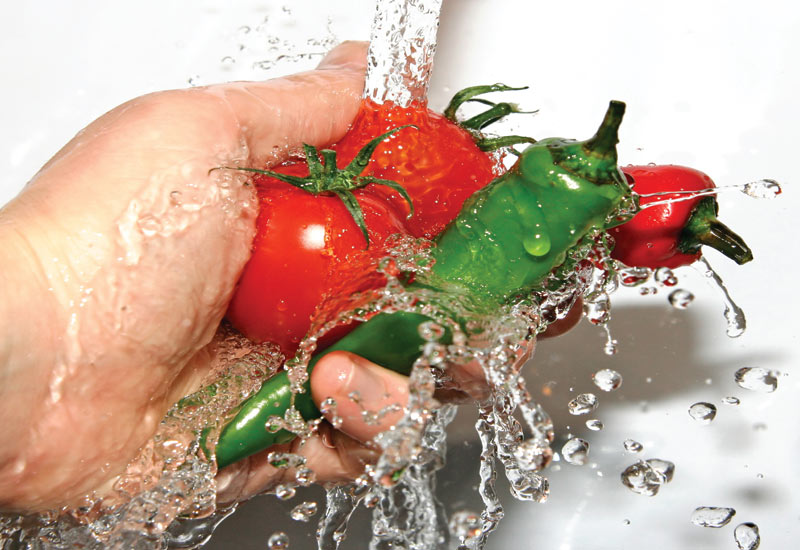
Following the best hygiene practice while dealing with food items is the key to avoid any food borne illness, which causes millions of deaths every year, says A Ganesh.
One of the gravest life threatening dangers in the kitchen largely comprises of food borne illnesses. Food borne diseases causes approximately 76 million illnesses globally, and 325,000 illnesses and 5,000 deaths a year in the United States alone, according to the Centers for Disease Control and Prevention.
In India, where there seems to be poor control over the rapidly flourishing food preparation joints, these figures would not be appropriate because very few cases are reported to public health officials.
Food borne illnesses are caused largely by disease-causing bacteria or by poisonous toxins which they produce. These bacteria can quickly spread and find their way into food via the food chain, that is, from soil and water, raw produce, kitchen surfaces, hands of food handlers, food handling equipments, food service utensils, to the food served.
The top three reasons for food poisoning include poor time-temperature controls, cross contamination, and poor personal hygiene.
Kitchens are hotspots for such opportunistic microbes. Moreover, during monsoons when diseases and infections are rampant, one would opt to be more careful on selecting the type of foods to be consumed.
Here are a few tips from our experiences, on preventing food borne illnesses in commercial and household food preparation areas and kitchens:
• Supplier safety assurance: Food safety starts with the supplier, so ensure that food materials and ingredients are purchased only from reputed, known, and approved suppliers.
Ensure checking of all consignments as per specifications. Be selective about certain seafood such as prawns, crabs, and shellfish, which can harbour infectious germs.
• safety conditions for water: Water is an essential component of the human body and is consumed in its original stage, and as a food ingredient. Contamination of distribution water can be rampant in rains due to leaking pipes and contaminated water at source, which if not adequately disinfected and treated, can harbour infectious microbes.
All water consumed as a drink must be thoroughly filtered and treated to render it bacteria safe at household level (water purifiers may be used), or, in the absence of the same, water should be disinfected.
• Disinfection of food contact surfaces: Use separate chopping boards and utensils including cutting and trimming implements, for vegetarian and non-vegetarian foods.
These should be disinfected between uses, especially for non-vegetarian food, and before being used to handle ready to eat food. Disinfecting can be carried out in boiling water for two minutes. Do not forget to disinfect knives and cleaning cloths.
• Time–temperature controls: The temperature danger zone (TDZ) for disease-causing bacterial build-up is from 5-60 degree Celsius. For frozen foods, the holding temperature should not exceed -12 degree Celsius, or temperatures that permit thawing. If your fridge is not equipped with a temperature monitoring device, you need to leave one inside to ensure that the temperature does not exceed seven-degrees Celsius.
Do not leave perishables or ready-to-eat food in the temperature zone for over four hours. If a microwave is used to prepare food, one must ensure that the food is heated to at least 70 degree Celsius.
• Clean as you go: Keep all food handling and storage areas clean and remove unwanted materials. Apply targetted use of an anti-microbial cleaning product for work surfaces which come into direct food contact, such as chopping boards and work tables; dish sponge, dish cloth, and cleaning cloth; fridge shelves, handles and gaskets; and electrical kitchen appliances which come into direct contact with food. Food service and preparation utensils should be cleaned within two hours.
• Waste handling: Do not leave garbage out in the open. It needs to be disposed off as quickly as possible in a proper manner. Get rid of decomposing food debris. Garbage bins should be lined with polythene and lidded when not in use, to discourage flies and prevent cross contamination. Ensure that all drains are protected with drain traps for cockroaches.
• Conscientious hand washing: Use soap and water with a rubbing action for 20-seconds, to clean hands. The rubbing action should include the palms, the dorsal side of the palm, the area between and around the fingers, the nails (could also be done with a nail brush), thumbs, and the exposed part of the hand up to the wrist or beyond, as applicable. The nails need to be short and rounded in any case.
Wash hands after using the rest room, after break, before start of an activity, after touching body parts, garbage handling, or any activity that could contaminate your hands. Remember, hands are an active carrier of microbes from the environment into your kitchen. Hand disinfection after thorough washing is best carried out with alcoholic rub-in hand sanitisers.


