“In the SHL teaching model, the relevance of skills’ training and practical know-how remains of utter importance and will continue to bridge the gap so that hospitality professionals not only know the ‘what to do’ but also the ‘how to do.”
Christa Augsburger, Director of SHL Schweizerische Hotelfachschule Luzern
For a sector as vast as the hospitality industry, its main tenets still revolve around a personable scale. Rapid digitization is an unavoidable reality today. But human touch, personalized care and curated interaction are what keep the industry truly thriving.
Christa Augsburger, Director of SHL Schweizerische Hotelfachschule Luzern, reiterates this philosophy, saying, “For all in-person touchpoints, the cornerstone of success lies in having employees specifically educated and equipped with soft and practical skills.”
Incidentally, SHL Schweizerische Hotelfachschule Luzern was founded in 1909 and is a top-tier professional-oriented hotel management institute with national and international recognition. Christa is a leading voice, shaping young professionals stepping into the industry. She purports that a customer service mindset, combined with theoretical knowledge, and supported by top practical skills are essential to deliver superior services.

An in-depth comprehension of end-to-end guest journeys is key to crafting successful experiences. Two factors govern the delivery of memorable experiences for guests – perfect coordination and ongoing optimization of all touchpoints throughout the guest journey, and a skilled and trained staff capable of delivering unmatched services and products. And this lies at the heart of the ever-increasing need for high-end personalized services.
Human touch has to go hand-in-hand with service quality and a nuanced skillset. At SHL in Lucerne, hospitality students learn practical knowledge and essential hard and soft skills that nurture their ability to adapt and grow in this fast-paced industry.
Christa explains, “In the SHL teaching model, the relevance of skills’ training and practical know-how remains of utter importance and will continue to bridge the gap so that hospitality professionals not only know the ‘what to do’ but also the ‘how to do’.”

As listed below, four facets of this well-rounded educational model drive the pedagogy at SHL.
Driving practical learning with technology
In the near future, facilitating practical and human application of theory will be enhanced by experiential learning, augmented reality, virtual classrooms and several more innovative tools to keep pace with emerging trends. Students will benefit from learning in a new way, combining cutting-edge technology-driven teaching models with valuable real-life training that prioritize human soft skills, revolutionizing not what but how hospitality management schools have taught for decades.
Optimizing for an interaction-driven business
In today’s highly competitive and dynamic world, developing a sustainable and competitive advantage is incredibly challenging. Since commoditisation is touted to be the new reality, human touchpoints and in-person experiences are the hospitality industry’s new competitive arena. Three touchpoints exist – digital, hybrid and some exclusively human. There exist better solutions than limiting oneself to only machine and robot touchpoints, especially in the hospitality industry, where intuitive human interaction plays a key role.
Hence today, SHL sees the indubitable importance of offering a multifaceted learning environment, where students gain theoretical knowledge and simultaneously gain opportunities to practice what they learn.

Education that simulates the real world
Internships, practical learning and hands-on training prepare students for real-life situations and are extremely important aspects of a successful hospitality education. This transformation of theoretical concepts to practical experiences instils in the students a sense of self-confidence, creativity and competence. A learning environment which allows students to demonstrate empathy and create a connection with their guests is essential.
At SHL, students typically tackle real-world business cases, thus cultivating leadership qualities and team-working skills.
Endorsing a human touch
Digitisation is no longer just a luxury of convenience, it has become a necessity. Digital technologies have and will continue to fundamentally change the world of customers, guests, students, industries, education, and all of our lives. And thus, the roles of humans with extensive theoretical and practical skills combined with technology are vital to creating an integrated customer experience.
Hospitality is not only a people-first business. Here, various skills are crucial in delivering great customer and guest experiences at every touchpoint. Hospitality is much more than what can be taught in classrooms learnt from textbooks. From a school’s standpoint, quintessential hospitality education is where theory leads seamlessly to practice, preparing students for the real world.
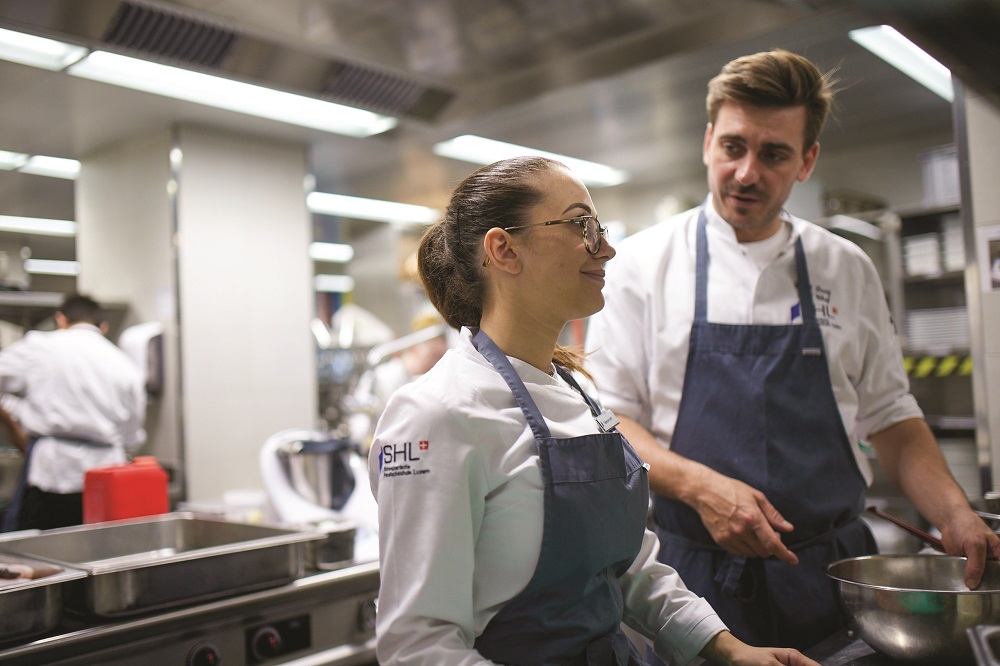
Hear from SHL students!
“When we talk to our students, they often share two reasons why they chose hospitality. Firstly, the fascination of the industry with its high human touch and all its opportunities to interact with customers and guests in different ways. Secondly, our well-balanced hospitality education programme with the right balance of theory and practice. Students emphasise that learning practical skills with the ‘How to do’ is what inspires and motivates them the most. They also see themselves as better prepared for their future career with these skills. We, at SHL, see the opportunity for practical learning and the attractiveness of the industry with its human touch-driven image as a unique advantage to attract more young people to our industry,” discloses Christa.
Brilliantly concluding the notions framed above, Christa says, “It is an extremely competitive world, and creating differentiation and unique customer value is more difficult than ever before. During guests’ stay, the one aspect they always remember and carry with them is how you make them feel; this kind of personalised mindful service is delivered thanks to a strong customer-centred mindset, whether or not technology is involved. That makes the hospitality industry unique, and this is the kind of legacy business leaders should strive to provide. We see skilled and perfectly equipped humans as a great strategy in customer experience management to make a difference. But to do so, practical skills are essential.”