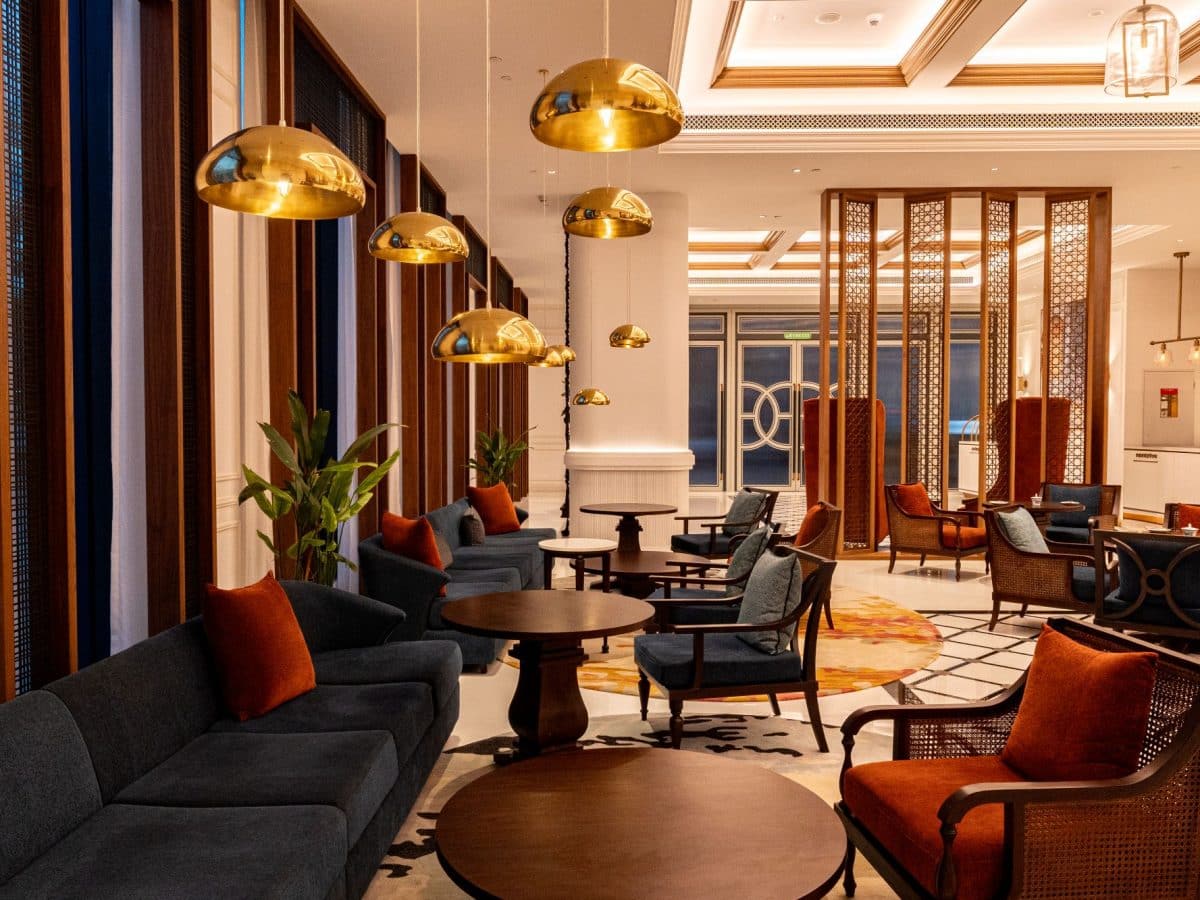

In today’s climate-aware world, sustainability in hospitality has transitioned from being a luxury to an expectation. However, truly climate responsive architecture transcends the mere addition of green features to conventional blueprints. It necessitates a fundamental shift in how we conceive, plan, and construct our spaces. This paradigm is particularly evident in modern hotel architecture, where guest experience and operational efficiency must coexist.
At Morphogenesis, we perceive sustainable design not as an aesthetic choice but as an ethical imperative; one that responds sensitively to climate, culture, and context. This philosophy is deeply embedded in our hotel projects, whether situated amidst the tropical greenery of Goa or on the arid fringes of Bengaluru’s urban expanse.
Climate as the First Client
Rather than approaching sustainability through checklists or ratings, we consider it an intelligent response to geography. The inception of any sustainable hospitality project begins with acknowledging climate as the primary influencer of form and function.
In Bengaluru, where daytime temperatures remain below 30°C for most of the year and relative humidity stays above 60% nearly 90% of the time, climate-responsive architecture isn’t just an option; it’s a necessity.
For instance, in the Taj Bangalore International Airport Limited project, sustainability began with a deep understanding of this local climate. This informed a design that performs efficiently with minimal mechanical intervention.
The hotel’s C-shaped configuration was a deliberate response to the site’s intense solar exposure. This form allowed the building to shade itself, reduce direct heat gain, and facilitate natural cross-ventilation throughout the interiors. By orienting key spaces away from the western sun, the design created a microclimate that supports passive thermal comfort.
This wasn’t just theoretical. Taj Bangalore achieves thermal comfort for over 75% of the year using passive strategies alone with the building’s thermal mass moderating indoor temperatures during cooler periods. Designing with sustainability in mind allows luxury to align with logic; producing structures that work with the climate, not against it.
Designing for Experience, Not Excess
Sustainability in hospitality doesn’t mean doing less; it means doing better. The modern traveler is increasingly conscious of how their experiences intersect with environmental impact. This awareness shifts the conversation from “luxury-as-consumption” to “luxury-as-consciousness”; valuing wellness, cultural sensitivity, and environmental responsibility.
Take The Yellow House in Goa, where a traditional Portuguese villa was adapted into a boutique hotel. Its restoration integrates multiple layers of sustainability; environmental, cultural, and social.
- Environmental sustainability was addressed through minimal site disruption. Excavation was reduced to preserve the natural topography, and existing vegetation; including a decades-old tree beside the pool—was conserved. The architectural layout followed the site’s contours, and new construction was integrated into the landscape. Passive design strategies, such as orienting the guest block north for glare-free daylight and enabling cross-ventilation, reduced energy demand. Local materials; terracotta roof tiles, Udaipur green stone, rattan screens, and handcrafted terrazzo tiles; helped lower the environmental footprint.
- Cultural sustainability was achieved by preserving original architectural elements. The villa’s ornamental mouldings, arched doors and windows, and trussed roof were retained and reinforced. The design maintained the historical character while accommodating contemporary hospitality functions like suites, reception, and dining areas.
- Social sustainability was embedded in spatial planning. Communal areas such as the central courtyard were reimagined for social interaction, with flexible seating and visual connections to guest rooms. Public spaces like the bakery and restaurant extended into alfresco zones to foster a more inclusive, interactive experience.
Weaving Regional Narratives Through Design
Climate-responsive architecture is inherently contextual. To be sustainable is to be specific; not only to climate, but to regional stories, skills, and systems. In the Taj Bangalore project, the material palette included locally sourced Sadarhalli granite. At The Yellow House, pigmented concrete and handmade terrazzo tiles were used alongside restored historical features and Goan cultural motifs.
The emphasis on local craftsmanship reduced transportation emissions and reinforced a design philosophy rooted in place. These choices support a broader vision of sustainability; one that celebrates vernacular identity while reducing resource intensity.
Redefining Comfort Through Responsibility
Hospitality design must address a central paradox: the industry consumes substantial resources to offer comfort, even as climate change threatens the very environments that make travel desirable. The challenge lies in redefining comfort through the lens of responsibility.
At Morphogenesis, our approach integrates sustainability into the architecture itself—from building morphology and microclimate modulation to energy loops and lifecycle considerations. Whether it’s harnessing daylight, reducing embodied carbon through intelligent material selection, or designing adaptive spatial modules, the goal is to create ecological performers; not just visually appealing structures.
This process requires collaboration across disciplines—architecture, engineering, landscape, and operations; starting from the earliest design stages. Sustainability isn’t something to be added later; it must be embedded from the outset.
Embracing a New Paradigm in Hospitality
As the climate crisis accelerates, the hospitality industry stands at a crossroads. Traditional practices are no longer viable; economically, environmentally, or experientially.
The hotels of the future will not be those that offer the most, but those that consume the least while giving back the most; to their guests, communities, and the planet. This is not an aspirational ideal; it is a practical necessity. And it begins with design.
Today, one shouldn’t view sustainability as a feature to be highlighted but as a baseline expectation; the new standard. It demands rigor, creativity, and humility; but above all, it demands that we listen. To the climate. To the site. To the people who will live, work, and rest within our walls. Because, in the end, sustainability is not something you add to a hotel; it is what makes it endure.