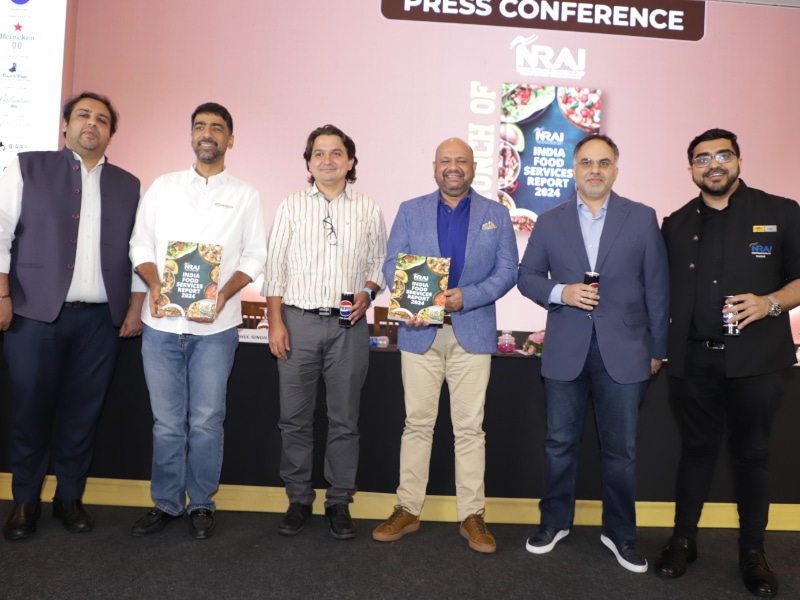
The restaurant industry is a significant contributor to the national economy. Apart from contributing significantly to direct and indirect tax revenues, it is also one of the highest employment creators in India and will directly employ 8.5 million Indians in 2024 and is expected to reach 10.3 million people by 2028. The size of the food services sector is 33.5x the Indian film industry, 2.18x of the hotel industry and 1.26x of the pharmaceutical industry. It is also the third largest industry in India valued at INR 5.69 lakh crores.
The National Restaurant Association of India firmly believes that with the right policy and budgetary support in the upcoming budget, the sector will experience quicker growth. NRAI is confident that this will not only expand the industry but also create significant employment opportunities in India.
With India set to be the third largest food services market by 2028 overtaking Japan and the second fastest growing food services industry globally after Brazil, NRAI humbly seeks the attention of the Finance Minister on the following issues, which will prove to be invaluable towards the development of the sector:
1. Restoration of GST Input Tax Credit (ITC)
It is the only industry to be pegged at 5% GST without the availability of ITC, a feature designed to avoid cascading taxation. The lack of ITC not only reduces the operating margin of the business significantly but also enhances the capital budget for a new project significantly. This increased project cost slows down the expansion plans, which massively impacts the overall growth of the sector.
The industry therefore recommends the restoration of Input Tax Credit to the restaurants while parallelly increasing the rate of GST to 12% from the current 5%. This may create a compliance burden on smaller businesses. To mitigate the issue, this can be done on revenue slabs. While restaurants below a certain revenue threshold can continue with the current GST provisions, the organised sector with higher revenues and CapEx outlay may move towards the proposed GST regime.
2. Separate Food Services Ministry/Department
We firmly believe that this could change the face of the industry and add tremendous impetus to the organised growth of this sector. The huge repertoire and variety of regional Indian food is one of the biggest soft powers that India possesses and is waiting to be unleashed. This can be one of the biggest ways to attract and grow overall tourism in India.
The total market size of our industry, i.e., INR 5.69 lakh crores, constitutes approximately 2% of our national GDP. It is also one of the biggest employers of human capital in the service sector. However, one of the biggest stumbling blocks to the sector is the lack of a single ministry that can help it grow in a planned and focused manner. It is a highly regulated industry, with policy and procedural interventions coming across levels ranging from local municipal authorities to the union ministry. This not only goes against the very ethos of Ease of Doing Business that the government espouses but it also leads to problems arising out of conflicting directions coming from different authorities. This significantly enhances the compliance burden, thus negatively impacting growth. Other sectors contribute much less to the national exchequer and employment generation but have dedicated ministries for themselves, which has helped the growth of those sectors.
NRAI, therefore, requests the government to create a dedicated ministerial department for the restaurant industry. Dedicated leadership, relevant policy initiatives, and a focused growth path can usher in unprecedented vibrancy to the sector.
3. Grant of industry status
Given the immense contribution of the food services industry to the country’s economy, it should be accorded an industry status. This will bring in multiple benefits through central or state industrial policies, including easier finance, special schemes, subsidies, fast-track clearance processes, etc. It will also encourage enterprise as well as entrepreneurship.
4. Rationalisation of licenses/NOCs
On average, a restaurant is required to get 15–25 licenses/NOC to open and operate a restaurant. This myriad of licences and permits inhibits food businesses from growing beyond their core geographies and adds to the operational complexity and compliance burden. As a part of the government’s Ease of Doing Business, the industry requests for a simplified and standardised policy across the country which will enable more businesses to explore and plan expansion across geographies creating employment and other network effects for the economy.
The creation of a separate ministerial department, as mentioned in the point above, will certainly resolve this problem.
5. Equitable and fair e-commerce policy
The online platforms, while bringing convenience, have also created concerns regarding fair competition and equitable growth. Balanced policies and regulations are required to enable a level playing field where platforms can continue to innovate while restaurants, delivery partners, and consumers are protected from potentially exploitative practices.
6. Reinstating service export from India scheme (SEIS)
The industry generates a substantial amount of foreign exchange for the country through forex-denominated credit/debit cards.
The SEIS scheme has been discontinued recently, and the same is recommended to be reinstated with a duty credit of 10% of the forex earned by the restaurant entities to boost the industry’s growth.
7. Employee welfare plan
The restaurant industry in India employs over 8.5 million people and being a heavily labour-dependent industry, it’s the second largest employment industry. Due to the long working hours and physical nature of work, this industry is not the first choice of the new generation, due to which the number of students signing up for professional courses in hotel management is declining.
As far as human welfare is concerned, currently, there are no special packages, welfare funds, or pension plans for the employees in this industry.
Therefore, the industry requests the government to introduce some innovative welfare plans funded by the central and state governments for the employees, supporting them during their employment and beyond.
8. Reduction of GST on commercial rentals (revenue share)
For restaurants, rentals form a large part of their fixed expenses and a high GST of 18% on this, combined with no Input Tax Credit being made available, is increasing the rental or revenue share expenses by a massive 18%. This causes major stress on the operating bottom line. The industry, therefore, requests either the restoration of the Input Tax Credit on GST or a significant reduction to GST on rentals and revenue share deals to 5%.
NRAI prefers the former to the latter.
9. Reduction of GST on bagasse and other eco-friendly materials
NRAI firmly extends support to all efforts towards enhanced sustainability. The use of bio-friendly packaging material for home delivery is one of the most significant steps towards it. Currently, a higher GST of 12% is levied on cutlery made with environment-friendly and biodegradable bagasse (pulpy fibre extracted from sugarcane juice) for delivery. On the other hand, a rate of 5% applies to cutlery made with plastic, thus pushing many small players towards using plastic. In a tight-margin food delivery space, these price differentials lead to slower adoption of eco-friendly products.
A reduction in GST will hugely accelerate the usage of eco-friendly packaging solutions.
10. Targeted subsidy schemes and access to debt financing for SMEs
The industry requests subsidies on essential ingredients, utilities, and waste management to reduce operational costs for struggling restaurants, particularly in smaller towns and cities. It is difficult for start-ups to access debt financing from institutional lenders at sustainable rates.
Subsidised lending will lead to growth in the sector with more and more people able to access financing.
Speaking on this, Kabir Suri, President of NRAI, said, “The food service industry in India is experiencing rapid growth and holds immense potential. As a key industry, the sector contributes 1.4% to GST collection and is today the second-largest employer in the country. In this budget, we are advocating for a single-window policy to expedite the process of opening and operating restaurants. Regarding GST, our industry currently does not receive an Input Tax Credit on expenses, and we are hopeful for a change in this budget to allow for Input Tax Credits.”
He further added, “Additionally, we propose a dual GST policy of a 5% GST rate and a 12% GST rate with an Input Tax Credit. This approach would enable us to offset current expenses, increase capital expenditure, open more restaurants, and ultimately generate more employment and revenue for the government. I am hopeful that the Finance Minister will consider our requests to boost the growth of the industry. I believe that our proposal for a dedicated Ministry or Department for the restaurant industry could be a game-changer, leading to exponential growth in the sector.”