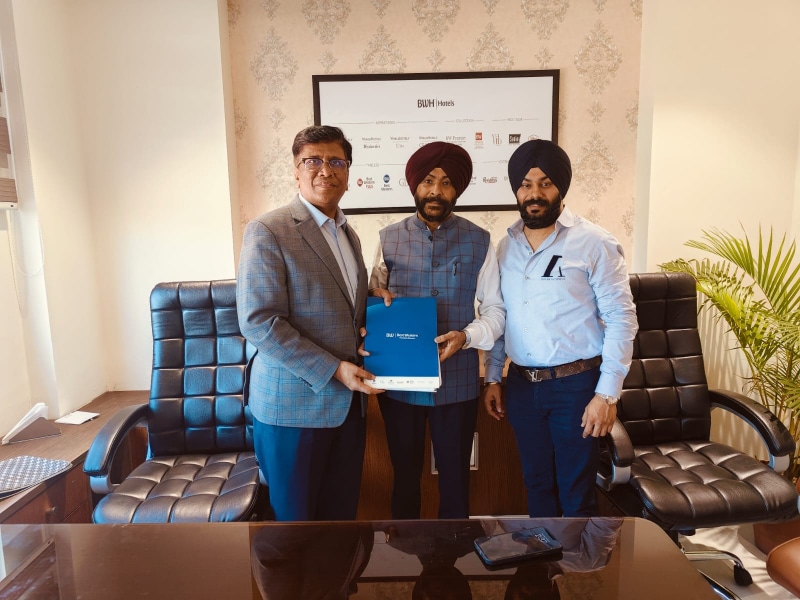

BWH (Best Western Hotels) is a leading global hospitality enterprise, based in US, comprising three hotel companies – WorldHotels, Best Western Hotels & Resorts and SureStay Hotels. The global enterprise boasts approximately 4,300 hotels in over 100 countries and territories worldwide. With 19 unique brands across every chain scale segment, from economy to luxury, BWH Hotels suits the needs of developers and guests in every market as each brand offers its own personality and style.
We catch up with the head honchos – Larry Cuculic, President and Chief Executive Officer, BWH Hotels; and Ron Pohl, President of International Operations and WorldHotels – in Delhi on their recent visit to India.
In a heart-warming and candid tete-a-tete, the enterprising duo and passionate hoteliers tell us what makes India a key market for Best Western – with a focus on growth and middle class expansion – and how their brand vision is a perfect fit for India.
Excerpts from the interview:
To begin with, our first question: What brings you to India?
LC (Larry Cuculic): We’re here to immerse ourselves in the culture of India, understand what makes a successful hotel in India, and also to support our master licensee here, Sorrel Hospitality (Atul Jain, CEO, and his team). We want them to know that we are focused on and care about their success. So it’s all about learning and supporting.
RP (Ron Pohl): The world, today, recognises that India creates a lot of opportunities across many industries. We’ve been in the Indian market for 17 years, and we’re very happy with the progress that we’ve made here. But with any global company, it’s important to understand the changing economy that is happening here, and how we can take full advantage of that. We can then go back to our teams in Arizona, and talk about what we need to do as a global company to support the growth, and help be more impactful.
So you see India as one of your big future markets in Asia?
LC: India is the world’s largest population right now. It is focused on the growth of the middleclass, and we think we are a great fit for the culture of the country as well. We don’t have shareholders like other global hotel brands, nor are we a publicly traded company. We’re only focused on the success of our hotels, which I think also matches very well with how business is conducted in India – based on the mutual respect and trust among people.
RP: If you look across the ownership group of Best Western and WorldHotels, we don’t have institutions that own our hotels; families own our hotels. In North America, 80% of our hotel owners have one or two hotels, and that’s been in their family for generations. We believe that’s the right way to approach the business, especially here in India, where families are so important. Also, our brand grew up in secondary and tertiary markets. That’s a great opportunity for us here as well.
As a 75-year-old company that is present in over a 100 countries, what are the legacies and brand philosophies of the hotel that you’ll are carrying forward? And do you see them being translated here in India as well?
LC: Our vision is a perfect fit for India. The brand’s legacy of inspiring travel through unique experiences is being carried forward in India. Sorrel Hospitality has great hotels in great locations here that inspire travel to those locations. Like we have a hotel that’s just 400 metres from the Golden Temple – a perfect fit for the location, one that inspires travel.
We launched a new brand at home, which is an extended stay product, wherein we see people wanting to stay in hotels for longer periods of time. Whether it’s because of manufacturing facilities and technology developing in those secondary and tertiary markets, there are travellers who travel to those locations wanting extended stay. I would encourage Atul to embrace that trend here, as he’s going to see the extended stay market emerge here too, courtesy changing demographics and needs.
So much has happened over the last few years, and obviously, the hotel industry has been one of the worst hits during the pandemic. What do you think has been the most impactful change post that?
LC: I love this question. People have embraced travel, and recognise the importance of travel in their life. Because when the pandemic happened, you couldn’t do it. And when you can’t do it, you appreciate it more. So I think people are travelling more than ever before, and want to create those unique experiences with their loved ones now than putting it off for the future.
So, yes, we’ve been hit very hard but we’re coming back tremendously strong.
RP: The first thing we recognised from the industry side of things is that we’re survivors. I mean, that was as difficult as my 40 years in the business. We’ve been through downturns and disasters, but nothing like the pandemic. However, we are especially proud as a brand as we didn’t lose our hotels. We worked with every hotel, to finance them, to help do what we needed to do for them to be successful.
Expanding on what Larry said, people not only desire to travel now, but the perspective on how they’re going to travel in the future has changed. Many people thought they could never afford to stay at a luxury hotel. But now they are placing a priority on travelling with family – to create memories. And if they have to save up for it, or cut costs in other places, they’re willing to do it. Now they want their travels to become purposeful.
With expectations from travellers rising, does that put pressure on hotels to live up to those expectations?
LC: It absolutely does put pressure on hoteliers to make that aspirational travel a reality.
RP: You know what the first part of all of that is? People taking care of people. And as we’ve travelled here in India, it’s amazing; the country could not be more hospitable. I mean, everybody is genuine and just absolutely amazing. The hardest part is having people who care – that’s something that’s hard to train; it’s got to be cultural.
LC: You have to have it in your DNA. In every hotel that we visited here, the staff is so friendly, they’re always smiling. As soon as you make eye contact with somebody, they smile. The service is just absolutely incredible. And that’s what makes hotels successful. And that, I think, is a perfect fit for us because that’s what we believe in.
I went down to breakfast the other day, and when I came back, my room was done – they took my towel and carved it into an elephant. That’s experiential travel. That service culture is amazing in India. We love it! And by the way, the food’s awesome. We love the food and the spice here.
RP: Half of our members in North America are Indians. So every time we have meetings, we have Indian food, as well as American cuisine. But the authentic Indian food here is so much better, and I’m not taking away from the caterers that we use in the States, but having the fresh spices in the food here has been tremendous.
Sustainability is the buzzword right now. So where does BWH stand on the ESG -Environmental, Social, Governance – front?
RP: Absolutely 100%. We were doing a lot of great things at our hotels across the world, but didn’t do a good job of capturing that. So the first thing we did was establish a global committee to understand each of the markets and countries that we have hotels in and what we need to do. We renamed the programme. We don’t like ESG – Environmental, Social Governance; it’s like a government-run programme. Ours is called EPC – Earth, People, Community – to make it more engaging and inclusive.
We did not create a department that was responsible. We made it the responsibility of every department because sustainability is all about people. We have to have a culture and team that believes in it – with focus on earth programs, charitable causes and responsible practices.