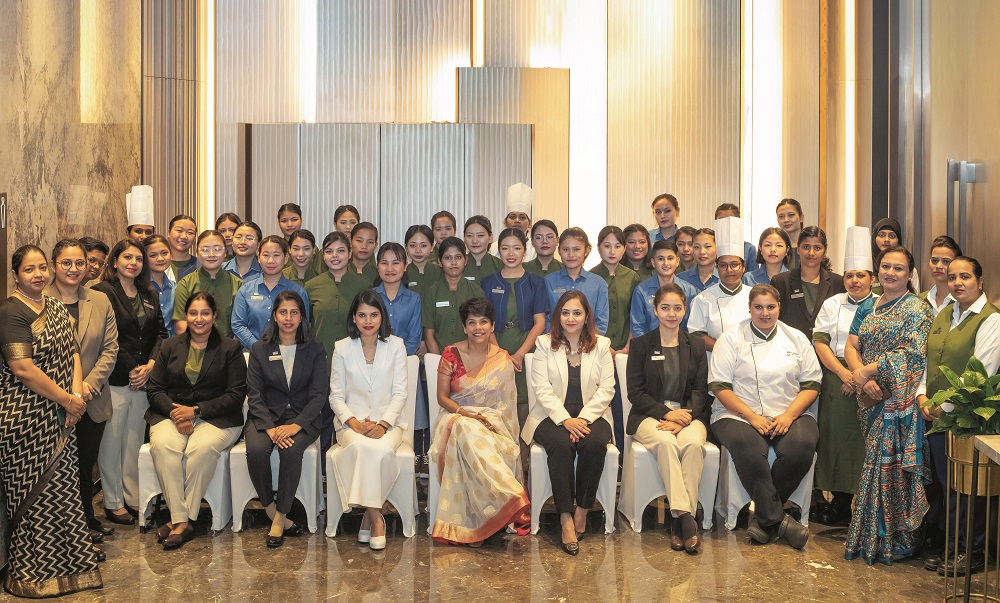

The ‘Women On Board 2020’ study by MyHiringClub.Com and Sarkari-Naukri.Info, threw up some heartening results. India was ranked 12th of 36 countries when it pertains to the presence of women members on the board. 55% of the 628 Indian companies surveyed have women directors, which is a 14% rise over the previous year.
Jasmine Sahney, Executive Director of Daaj Hotels & Resorts Ltd. (the company that owns Radisson Blu Hyderabad) is delighted women professionals are finally getting the respect due to them with a seat at the table.
However, reaching this milestone was not easy. Up until a couple of decades ago, the norm for most Indian ladies was to study, get married and eventually raise a family.
“It is only recently that this positive change began with more women joining the workforce and moving up the ranks. Men had a head start in the corporate world. This explains why we still see more of them in senior positions, dominating boardrooms,” she explained. However, with Indian women continue breaking stereotypes, it is only a matter of time before they catch up with their male peers.
STRESSED ABOUT STRESS
The stress levels can often be quite high in the higher echelons of the corporate structure. Managers often subscribe to the ‘always on’ work culture and need to be accessible at all times, while juggling increasing workloads. According to a report by Cigna, women professionals end up getting more stressed than men, since they also have to manage family and work.

Fortunately, women have slowly learnt the art of juggling their personal and professional tasks. Sahney pointed out that the current generation, especially, has an evolved mindset, where the gender roles within a family are not strictly defined and there is more balance in sharing of responsibilities.
This is reflected in the growing number of women steering their organisations. One just needs to look up to Kiran Mazumdar-Shaw, Chairperson of Bicon, or Preetha Reddy, Shobana Kamineni, Suneeta Reddy and Dr. Sangita Reddy who comprise Apollo Hospitals’ Board of directors.
Even the hospitality industry has women powerhouses like Jyotsna Suri, Chairperson and MD of Bharat Hotels Limited, Priya Paul who heads THE Park Hotels; Deepika Rao, CEO and MD of Ginger Hotels, and Anshu Sarin, CEO of Berggruen Hotels. These women achievers have also proven that it is possible to balance family and personal obligations, earn equal pay or negotiate with hospitality brand owners, with aplomb.
EMOTIONAL QUOTIENT
Another misplaced notion that has placed hurdles in the career trajectory of many a woman professional is that females are too emotional and unable to deal with situations that call for tough decisions. Calling this presumption absurd, Sahney questioned why should a heightened emotional quotient be considered a disadvantage?
“On the contrary, with evolving corporate culture and companies becoming more employee oriented, not to mention the increased level of workplace stress, having managers who understand how to deal with emotions is a huge plus,” she pointed out. Moreover, as dexterous multi-taskers, women can compartmentalise issues with greater ease, which makes them as capable of leading as men, if not more.
When Whitney Wolfe Herd, Founder and CEO of Bumble became the world’s youngest self-made female billionaire, many lauded this achievement. However, let’s gain some perspective. According to the Bloomberg Billionaires Index, self-made women account for less than 5% of the world’s biggest fortunes, even though females comprise 50% of the world’s population.
One big obstacle in any women-led organisation is receiving funding. Pitchbook data found that startups founded by women, has been receiving less than 3% percent of venture capital for over the last decade. This is extremely surprising when pitched against studies by BCG, Kauffman Foundation and MassChallenge that found that companies founded and operated by women generate more revenue than their competition.
Sahney, fortunately, never had to deal with this stereotype and gender rarely played a role in tough fiscal discussions. According to her, the factors that truly matter are the individual’s capabilities, their competence, the project in question, how well they can present the need for funding, etc. If someone does throw a gender-bender at her, she just shrugs it off!
“I don’t let bias affect me, because if I start seeing myself differently then I give others the license to treat me differently too. There are several women leaders in the industry currently. They are capable of commanding respect as hold their current positions because they have proved their merit,” she asserted.
WOMEN HOTEL OWNERS
Until a decade ago, women hotel owners did have to deal with some bias. However, when she looks around her and sees how the younger generation operates, Sahney is delighted that a lot of ground has been covered.
Though she did not face any major gender-based obstacles, she recalled how people would not take women professionals seriously sometimes or try to undermine their capabilities. “One can overcome this by displaying confidence in their strength and proving that they know what they are doing and leading from the front, thus earning people’s respect,” Sahney suggested.
It has also helped that companies are taking gender equality more seriously now. Sahney is happy to note that policies pertaining to women at the workplace are more evolved currently than they were back when she started her career. “The gender divide is surely narrowing and I see equal opportunities actually taking shape in the job market,” she noted contentedly.