The global economic downfall may be over, but the hospitality industry has learnt its lessons. With a trend towards cautious and more deliberate spending across the sector, hotels are choosing their projects wisely, focusing on what will make the greatest positive impact. The hospitality market is now a lifestyle business, catering to the customer’s practical needs. This change of thought is evidenced in material selection and design. High-end hotels used to cater to the rich and famous, grooming an elite image that made them seem out of reach for those outside of the top tax brackets. That is no longer the trend – opulence has been replaced by approachability.
Flooring happens to be an integral part of the image that a brand conveys to a guest. Significant shift from soft to hard surface flooring continues in hospitality and the trend line is favouring the demand side of the equation.
At the same time, the hospitality market is hoping to maintain those extended lifecycles with less trendy products that look good longer. For soft surface flooring, that means five to seven years for guestroom carpet, and seven to ten years for public space flooring, about the same as hard surface flooring. Designing for hospitality, A&D community is prioritising material that offers durability. Hospitality environments endure a good deal of abuse under high heeled shoes, wheeled luggage and the set-up and take-down of chairs and tables used for banqueting events.
Country manager Hardeep Singh of Forbo Flooring Systems shares, “A typical hotel design would comprise of several areas and choice of floor covering would depend upon the aesthetics, maintenance and utility of that particular area. Granite, carpets, resilient flooring (Linoleum/PVC), are some examples.” The choice of floor covering depends upon the overall budget of the project.
Guest room flooring is typically replaced every five years and common areas every 10-15 years, though some brands call for updating more often to maintain a clean, fresh look and a competitive edge. Floor coverings need to be durable and help reduce maintenance costs. When specifying for remodels, the replacement needs to be able to move forward with as little operational disruption as possible.
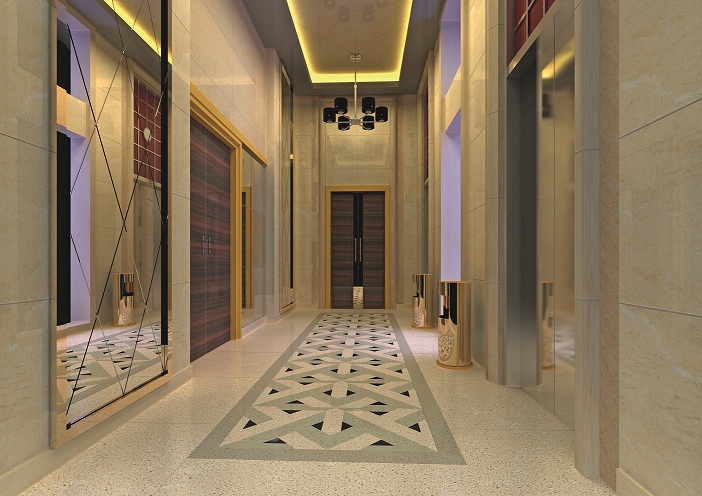
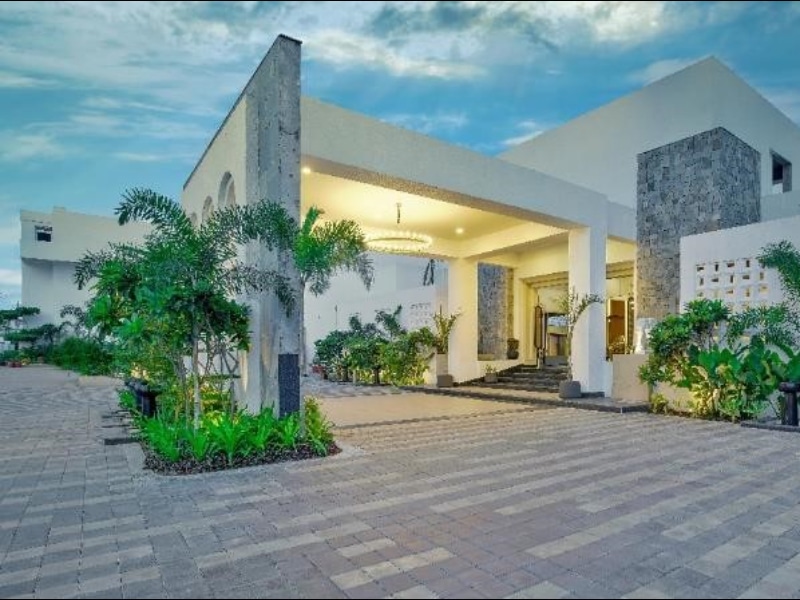
Lobby is the first impression, so, regardless of the material used, the hotel will always want to tell a story, to make the guest feel a certain way. All sides of the room must be taken into account and a well grounded understanding of how they speak to one another. The vocabulary has to be cohesive throughout. The impression created in the lobby needs to continue through to the elevator lobby, corridors and guest rooms.
Director Subodh Shah of Classic Marble gives his insight, “Be it hospitality or any other commercial premises, flooring is no longer just about the looks. A good flooring has to meet certain criterion be it about durability, or ease of maintenance and style of course is, if not the only factor but a significant one. Apart from these, many other factors have to be kept in mind. Sound absorption, music, crowd usage, a floor which will have frequent footfalls cannot be too flooded itself.
“So flooring has to be a fine balance of multiple factors and in the last few years trends in flooring have certainly changed for the better. Mainly, options like carpet, which was almost a mandatory requirement has gradually given way to exotic and long lasting marble – be it natural or engineered – due to high maintenance costs. Engineered stones have low maintenance, uniformity and availability of huge quantities as per the project requirements. Custom made designs in ‘engineered marble’ are the most sought after as it is manmade and desired size, colours and patterns can be produced and made available in a short span of time,” continues Shah.
Raj Menon, country manager, Interface flooring adds an interesting angle, “In case of conventional flooring material, wastage can be anything from 10 to 13 per cent, whereas with carpet tiles it is just 2 to 3 per cent. Carpets reduce the dust circulation to a great extent as dust does not float as on hard surfaces. Also, the acoustic properties of soft flooring are vastly superior to others.”
Engineered marble has enormous advantages over other flooring options. Few of them include: Supply: large quantities can be provided within short time scales, making it ideal for large projects. Furthermore, the material can be supplied in a limitless range of colours; Repeatability: the same colour can be recreated by repeating the original manufacturing formula; Uniformity: of the material in physical, mechanical and visual characteristics; Uniqueness of colour and pattern: as it is a technologically reconstituted material, new materials can be created with visual characteristics that are not available in nature; Product exclusivity and creativity: the project designer can contribute directly to the creation of new colours and visual effects; Variety: slabs, tiles and processed articles are available with surface finishes that are polished, bush hammered or sandblasted in every colour in the range; Easy to lay: available in desired thicknesses.
Ceramics have advanced by leaps and bounds, and more than anything, have changed hospitality design. You can get a stone look for a lot less; it is maintenance free; and no one knows the difference. Wood-look ceramic tile, too, is a great example. Wood, while beautiful, has maintenance and durability challenges for a location with high foot traffic. Wood-look ceramic tile, however, provides the same feel on a material that is well suited to the hospitality environment. When it comes to floor coverings, building teams can select from a broad menu of products, including carpet, polished concrete and resilient surfaces like cork, linoleum, rubber, and vinyl. In the last few years, however, luxury vinyl tile (LVT) and carpet tile have been carving out a bigger chunk of the commercial flooring market, especially against broadloom products.
In addition to its high design quotient and durability, porcelain tile is sustainable, allergy free and can contribute to LEED points. Hospitality flooring is becoming more monolithic and cleaner style-wise with fewer grout lines and larger scale patterns. Reclaimed wood communicates a cosy feel and a commitment to environmentalism, while carpet tile is versatile, easy to install and easy to replace (piece by piece), it is used in hospitality more frequently.
For a lobby, vestibules with walk-off areas or mats are vital for prolonging life of the floor and reducing operational costs with cleaning and maintenance. Registration areas and elevator lobbies will receive a high level of foot and rolling traffic which may be best suited to a ceramic tile, stone, or polished concrete floor. Adjacent areas for dining and lounging should have smooth transitions to the lobby area.
Corridors have a tendency to funnel and amplify noise so special attention needs to be paid to noise reduction and carpets can assist with this. Majority of traffic in corridors is down the centre, complimentary borders can reduce the need to replace an entire hallway, reducing replacement costs. Using an accent colour at corridor intersections to turn patterns can be used. This will prevent seams down the corridor. This can also be done for door insets at room doors which tend to be grouped together in fours.
The backhouse areas of a hotel have often witnessed the use of bare concrete or VCT in an effort to reduce costs. While this may be true initially, maintenance costs and upkeep, and safety concerns can offset any savings. There are several options that provide safe, durable, low maintenance conditions, polished concrete, sheet vinyl or rubber, ceramic tile, and resinous systems.
Abhishek Saraf, joint MD Sqaurefoot reveals that hotels generally prefer dark flooring. The latest offering by the brand is Walnut Herringbone that lends a very unusual look to the room. Beech and Oak in European wood, too, is preferred. Kaya Kuku is another product by Squarefoot that has characteristics similar to hard wood that has the capability to prevent furniture marks. Woodwall panels, too, are a new eco-friendly alternative.
Forbo provides a complete flooring solution. The product basket comprises of Flotex, the Flocked Carpet floor covering, which is washable and easy to maintain. Marmoleum (Linoleum) is another product which is one of the greenest flooring available in the market. Marmoleum is 97 per cent made out of natural raw materials and 70 per cent of its raw materials are Rapidly Renewable, and it also contains 40 per cent recycled contents. It’s a product which comes in a vibrant choice of colours that could bring life to the floor. One of the most important offering is Coral Entrance Matting system. As the name suggests, this entrance matting removes 90 per cent of walked-in soil and moisture thus reducing maintenance cost of the floor covering inside the hotel building.
At Classic Marble Company, engineered marble and quartz are manufactured by state-of-the art machines using European technology, thus products are of world class standards. Their products are being marketed in Europe, South East Asia, Australia, Africa and the Middle East. The company offers a variety of 150 stones which gives the customer an array of choice.
One of the marble from the engineered division is Azul which belongs to the Petra series. Azul when combined with white or grey colour marble options gives a very chic and corporate look to the floors. It can also be used as a sole flooring option as per the combination palette of one’s interiors. This is ideal for hotel lobbies, reception areas and meeting rooms. Azul is an engineered marble made up of 93 per cent natural stone powder and when used on flooring has an edge over tiles due to its durable strength and rich feel.
Design Your Floor – is an Interface hospitality mantra, where they offer an extensive selection of patterns that can be specified in a wide range of colours and then configured into flooring landscapes that become distinctive. The product assortment is impressive and patterns are classified as either classic, modern, organic, traditional or whimsy. Styles run the gamut, from densely decorated geometrics to a large scale stylized floral to 20th century interpretations of oriental motifs.
The company’s TacTiles installation system secures tiles to each other, not the floor, without messy, sticky glue. “Our proprietary broad spectrum preservative, Intersept, safely and effectively protects our carpet tile from mould growth and odours,” reveals Menon.
Irrespective of the area in the property, flooring plays an important role in creating the right perception in the minds of the guests and hotels are paying heed to it.
Floor to floor
(NULL)

SHARE