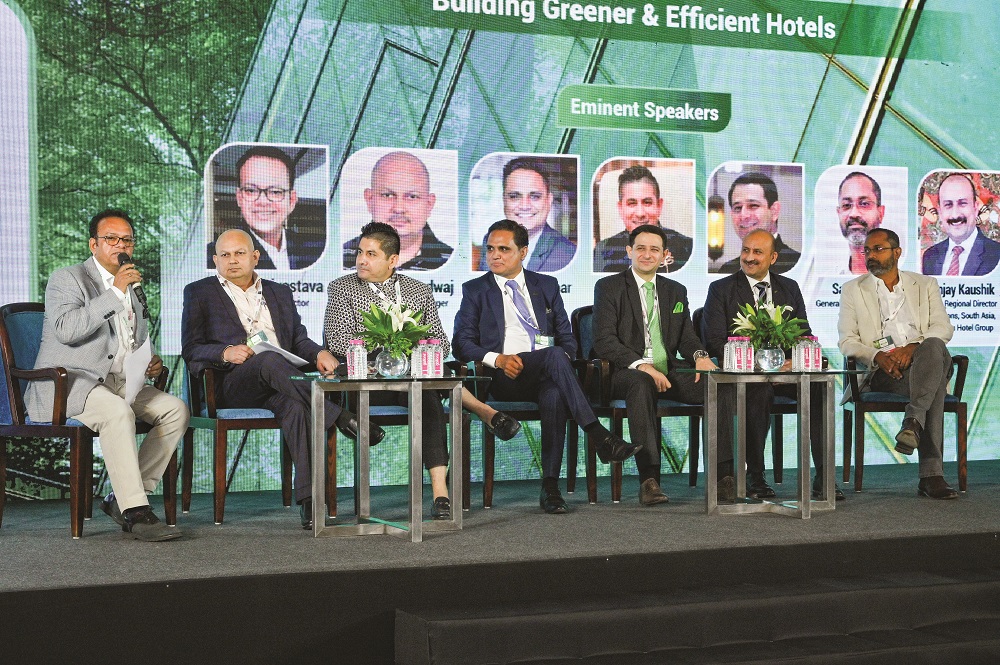
This is probably one of the most dynamic industries in the world. And the main reason for this is that a growth in any sector means executive travel and better spending power — cumulatively leading to revenue for the hospitality sector. With the economy showing signs of being bullish, the country is poised on the threshold of a better future, leading to better business for hotels across all segments. However, is the hospitality industry equipped to meet the challenge?
Hotel Build is the platform for industry leaders to come together and chart out the way forward in order for the industry to offer the best to its customers. This year, the conference’s aim was to get industry experts together to provide unique insights and authoritative debates into the emerging, cost effective construction, architecture and design techniques that can propel the build of hotels across all segments to commercial success.
Building cost effective hotels with less labour, delighting the customer and getting the best RoI for the investor are some of the main concerns for stakeholders across the industry. There is a growing need for hoteliers, developers, project heads, procurement heads, architects, designers and consultants to work as a team to give shape to a dream.
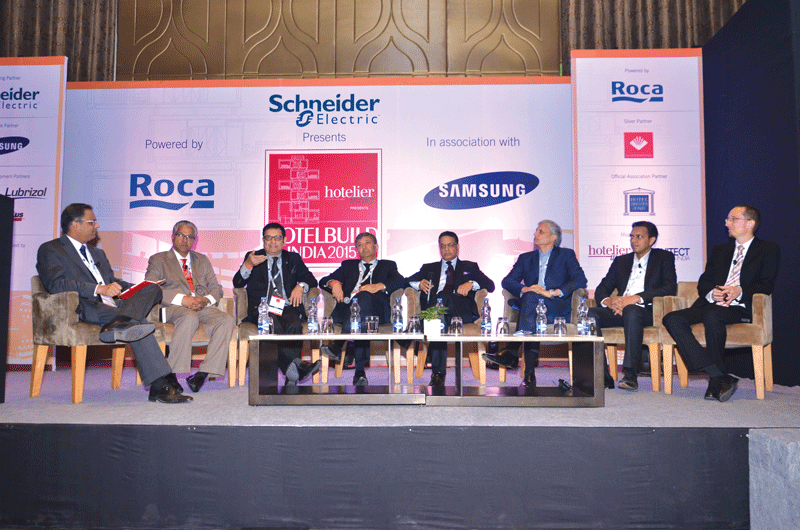
Hotel Build 2015, held at Westin Gurgaon on March 20-21, began with the opening address by Saikumar Shanmugam, deputy MD, ITP Publishing India, followed by a welcome note by Vivek Yadav, VP, Schneider Electric. A keynote address was delivered by Rahul Kadri, principal architect, Kadri Consultants, on teams and processes of design and trends in development. Kadri highlighted the lack of processes that could help avoid delays in project completion, trends in hospitality design (which are affected by the growth in aviation and corporate world) that had led to the growth in the hospitality industry from the very beginning.
Kadri pointed out that in today’s scenario, it is important to future-proof the hotels, and emphasised that design needs to enhance the experience of the guest. “The marketing department should be a part of the core design team as they are the interface between the property and the user; they know what the trends are and what people want,” Kadri suggested, adding that the most important process that needs to be followed and isn’t, is prioritisation.
This was followed with a presentation by Laurent Coene, global solution architect, Schneider Electric, on how putting the right systems in place would reduce the cost of building and then increase operational efficiency and guest satisfaction. According to Coene, integration is the future — integrated and connected solutions in order to improve guest comfort and satisfaction as well as to make the jobs of the operations team as convenient as possible.
Following the presentation by Sachin Kapoor, deputy GM, Tech Solutions, Samsung India, titled ‘Hospitality That Remembers’, was the CEO panel leadership debate on best practices, moderated by PR Srinivas, director, Hospitality, Cushman & Wakefield India. The panel comprised Deepak Uppal, executive director, Vatika Group; Naveen Jain, president, Duet India Hotels; Ajay Bakaya, executive director, Sarovar Hotels; Satyen Jain, CEO, Pride Hotels; PK Mohankumar, MD & CEO Roots Corporation (Ginger hotels); UV Krishna Mohan Rao, chief executive, UV Krishna Mohan Rao Associates; and Coene. It focused on what is a CEO looking at from a development and design process and how would one make these projects work over a long period of time? The idea was to explore what drives businesses. One of the core issues discussed was the role of a CEO in the design and development of a project.
According to Bakaya, “The team has to be comprehensive and strong, and the job of the CEO is to challenge and bring out the best in them.” Naveen Jain added that the involvement of the CEO is a must, right from the concept stage for effective time and cost management. “The only thing that a CEO should not do is to ask for changes after designs have been signed off,” he said.
Mohankumar felt that the job of the CEO is to bring in different perspectives and he has to be the catalyst amongst all stakeholders but to avoid getting into the nitty-gritty of a particular function. Uppal, on the other hand, believes that the complete onus of responsibility to ensure that the design and build of the hotel is done properly and on time within the budgeted cost and in the right, first-time approach lies with the CEO.
“Location determines the kind of property we will develop,” added Satyen Jain, who felt that the design brief has to be crisp and to-the-point for a good design. Rao felt that the results are always proportionate to the CEO’s involvement, especially in issues like sustainability.
There was a consensus that mixed-use properties are the future of mid-scale hotels. This segment faces a lot of challenges in terms of ownership, services, etc and the CEO has a major role to play in that.
The following panel discussion on profit by design was moderated by Madhu Chandhok, founder-partner and director, Pip2020, with panellists Adrain Hardwick-Jones, regional director & engineering SWA, IHG; Kalhan Mattoo, director and principal architect, Planet 3 Studios Architecture; Rahul Kadri; Prashant Sutaria, principal architect, Prashant Sutaria Architects; and Ranvir Bhandari, VP, operations, ITC hotels.
While they all agreed that design matters, it has to be in-sync with and work for revenue generation for the property. Hardwick-Jones added that design has to be translated into a business model. Mattoo opined that good design is not only about aesthetics but that it is also about all the things that are important to that project. “It is like solving a multi-variable equation,” he said.
Bhandari added that, in his opinion, design that works towards the effective and efficient delivery of brand values is good design. “In India, conversations are always about cost savers and not value generators. The creative process is all about how to maximise the revenue coming in, that is what design needs to do,” said Hardwick-Jones. Mattoo felt that architects here are paid a fraction of the cost of the project: “Good design always pays for itself but not in India.” He felt that somewhere down the line, the creatives have failed to make the owners understand the value of what an architect brings to the table, and that there is a need for owners to be enlightened about the value.
Kadri admitted that while there is no problem in communicating design to the client, he has a problem in communicating his own value. To which Sutaria added that negotiations till the last minute on the architect’s fees tends to lead to copy-paste projects and this is not something anyone would want.
Mattoo added that brand as well as hotel owners and developers should realise that getting an architect is not a procurement process. Bhandari felt that there is a need for constant education between the designer and the operator to save operation costs, “as deviation from the original brief is so significant that the essence of the project is lost”.
The panel discussion on project cost and development cost per key with project financing opportunities was moderated by Babul Ganguly, COO, project development, Duet India Hotels, with panellists Cyrus Madan, VP, development and feasibility, The Lemon Tree Hotels; Manish Sachdeva, associate director, Archetype Group; Praveen Khurana, national sales head, Roca; and Chandhok.
Optimisation of design and planning is most important in controlling costs. Madan elaborated that freezing all the concepts beforehand is of primary importance and this is not difficult in the mid-segment. Standardisation and simplification of the design process helps in increasing efficiency and delivering in time. All the key stakeholders should be on the same page right from the planning stage so that all problems can be resolved and the project moves on course. Due diligence is important to keep a check on processes and costs.
Harish Chandra, GM, IT, Sarovar Hotels, moderated the panel on hospitality trends in technology sector, which had Vipin Khadelwal, hotel openings and global technologies, InterContinental Hotels Group; CG Prasad, corporate GM, Operations & Technology, Eco Hotels; Rajesh Mohan, GM, Strategy, Planning & Technology, Hotel Sahara Star & Aamby Valley City; Sachin Kapoor, deputy GM, Tech Solutions, Samsung India; and Sukanta Dey, former advisor to the board of Telecom Globocom Ltd, West Africa.
The panellists discussed the trends in technology that would pamper and treat guests like royalty along with the growing trend of using apps to run operations efficiently and also increase business. They felt that one needs to learn from the airline industry to increase ARRs. “Everyone is moving towards the digital lifestyle and to increase the stickiness of your customer, you need to give him or her the best digital experience,” said Dey. This, Khandelwal felt, is important as the consumer use of technology has gone up.
The day ended with the Hotel Build Awards, celebrating the best of hotel build, architecture and design (see details on Pages 80-81).
| O |
n the second day of the conference, the focus was on the mid-market and budget segments of the industry. The tone was set by the keynote delivered by Rattan Keswani, deputy MD, The Lemon Tree Hotel Company and chairman, Carnation Hotels. “The trends of today as we see them and the trends of tomorrow as we hope they will emerge in the future, are really a determinant of how everyone understands the concept internally and understands what the market wishes us to do,” Keswani said, elaborating, “that these concepts are acceptable to the customer but are they communicable to the customer as true value and then are you able to bring the promise to the owner or developer who is investing in evolving this concept?”
He rued the fact that price yield defines the concept in India and that, he felt, is the problem. The definition and services of economy hotels in India are different from those abroad “simply because our users have not been rightly guided by us about the meaning of mid-scale and economy hotels” he said.
Keswani’s address was followed by a CEO panel discussion on commercialising budget hotel builds in India, making effective use of FSI and striking the balance between space optimisation, guest comfort and affordability. Moderated by Nikhil Sharma, COO, Red Fox by Lemon Tree Hotels, it had Mohankumar, Romesh Kaul, CEO, Lords Hotels & Resorts and architect Sutaria. They shared that, in India, the success of the property depends greatly on the location and to have a successful model of a smart hotel in a metro city, it has to be in a multi-use space to be cost effective.
Proper planning and budgeting is a must and FSI has to be put to the best use for maximum RoI. “India is a nascent market for budget and mid-market hotels and we need to understand the difference in terms of the services. Mixed-use commercial projects are a way in this direction and one has to stay invested for the long term,” concluded the panel.
The final panel discussion of Hotel Build 2015 was on sustainability in hotels that spoke about aiming for operational excellence, renewable energy, clean air and water resource management. This discourse was led by Basil Massey, director procurement, Duet India Hotels, along with panellists Prem Thakur, senior manager, Global Design & Project, Asia Pacific, Marriott International; Sunil Mathur, corporate advisor, Lords Hotels & Resorts; and Madhu Chadhok. The panel pointed out that the success of a hotel also depends on sustainability as it is no longer a USP but a way of life for hotels. It is important to have the systems of sustainability in place to increase efficiency of the property. The sustainable processes need to be budgeted right from the start and not be an afterthought for them to become a part of the hotel’s DNA, they concluded.