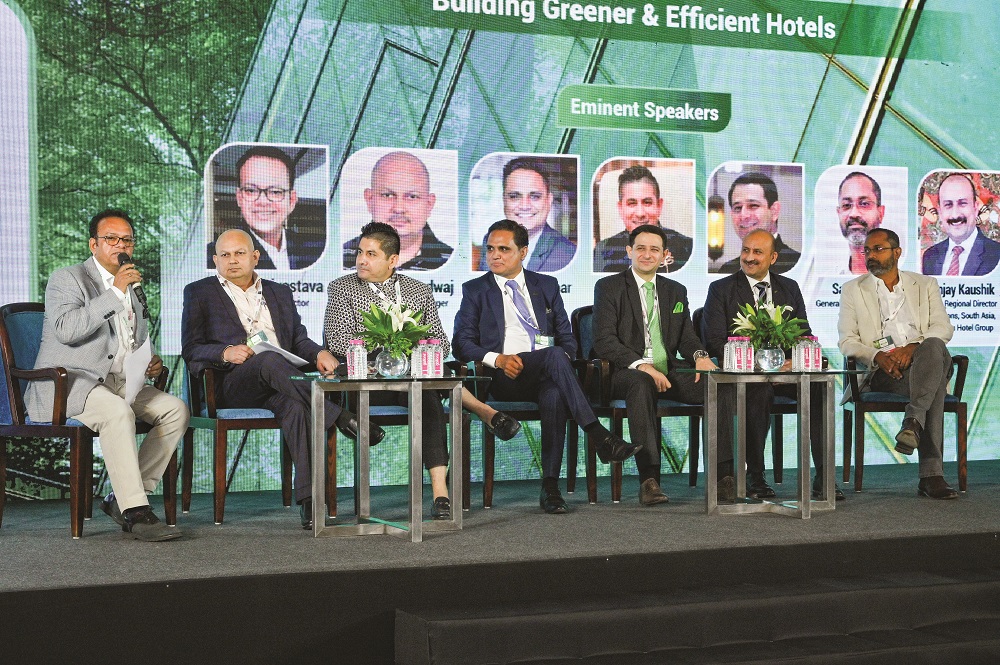


Pioneering a series that delves into the role of ever-evolving technology integrated within every aspect of hospitality, the Think Turf forum sought to address the topic in a holistic manner. Convened in Goa on March 27th, 2015, the evening witnessed the gathering of managers, engineers and industry professionals, keen to explore the notions of technological ideas and their implementation.
Charles Bonifacio, president, SKAL International Goa, opened the evening with a note on the growth of India’s hospitality and tourism sector. Assessing the travel and tourism trends in India, Bonifacio said that at the end of last year the total market size of India’s tourism and hospitality industry stood at $110 billion, with an anticipated projection to reach four hundred billion dollars by 2022, mainly driven by the enhancement of technology. The global hospitality industry has reached an interesting juncture where hotels are increasing their leverage on innovative technology to boost revenues and profitability. He outlined the fact that, “Improved and enhanced guest experience through technology has an irreplaceable role in every aspect of the industry. Today PMS has become more powerful with features that enhance more efficiency improve control, enable faster delivery and ingenerate guest loyalty.”
Bonifacio spoke about iris-scan technology and motion sensors, and how cloud computing has made managing day-to-day business very efficient. A new trend that the Indian hospitality industry is fast adopting is the check in app, similar to the aviation industry, with which one can check in room his or her room from anywhere in the world. He opines that with such advancements the hospitality sector is truly on its way to become highly technology oriented.
Bonifacio’s address was followed by a presentation by Puneet Sethi, director – enterprise business, Samsung, who spoke about the company’s initiatives and development in this sector. On the same cue, Sachin Kapoor, DGM – tech solutions, enterprise business, Samsung, illustrated his talk with the help of a comprehensive range of products and services from their HVAC and VRF segment.
The evening then proceeded to the panel discussion, moderated by Bibhor Srivastava, group publishing director, ITP Publishing India, who opened the forum with a question about how technology has helped exceed guest expectations but lacks personalisation. To which Saurabh Khanna, GM, The Park, Calangute responded, “Hotel managers have to look at the guest and property profile before adopting a certain technology, as different businesses would have different requirements. Thus, one has to look at technology as an enabler, enabling us to provide a better experience. Just because one hotel is doing it, does not mean it would be suitable for all. It is a differentiator.”
The discussion then steered to the adoption of technology in budget hotels and its feasibility. “In terms of the budget segment, the guests are very well versed with technology, mainly because the age group is usually between 25 to 40. We get guests, who are tech friendly and open to different options in terms of making their life in hotel much more convenient and easy,” observes Anderson Noronha, GM, Lemon Tree Amarante Beach Resort, Goa. He then explained the PMS system at the hotel, which has enabled them to update guest profiles and preference details on to the cloud. The other branches in different cities can now access this at the time the guest checks in to be equipped with information beforehand. This has helped the hotel to create lot of loyalty.
Though digitalisation and automation is inevitable, the adoption of this trend is still a slow process in India. Sethi states that Samsung is one of the few companies that is committed towards the research and development of creating new products. In terms of hospitality, there is a lot of development going in to churn products that help improve guest experience.
The forum concluded on a note that addressed the conflict between the asset owner and operators, given integration of technology comes at a cost. Noronha concluded the forum with the fact that in the end it is essential the owner recognises the value of the cost and the long run advantages of the investment.