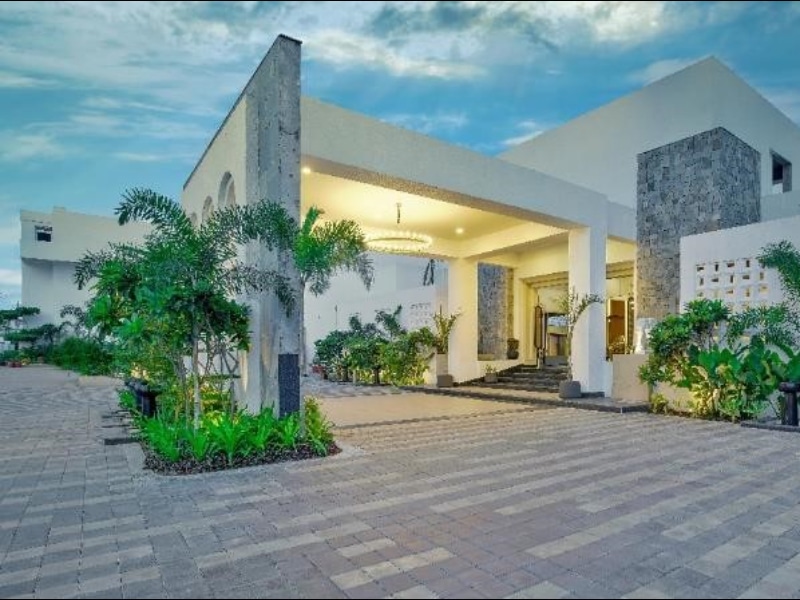
Boasting best-in-class properties like The St. Regis Mumbai and W Goa, Amit Bhosale, managing director, ABIL Group, is set to rule the luxury space
By SHAFQUAT ALI
GREAT EXPECTATIONS
While construction has remained ABIL Group’s focus, the company’s has made a strong dent in the hospitality sector. In addition to heading the company’s real estate business you have ably steered the company’s hospitality business and are apparently looking forward to 2016-17 with great expectations. Are things panning out the way you had expected?
Well, the excitement was obviously for W Goa since it was the first W to open in the country. That was one of the hotels that a lot of us within the company were excited about.
And The St. Regis Mumbai, which is also the first St Regis to open in the country?
Yes, W Goa was one of the key excitement points but even bigger than that was The St. Regis Mumbai for obvious reasons. It was getting into a year of full St. Regis operations after we rebranded it [from Palladium Hotel]. You have got to give them the initial days of settling down; a phase where they stabilise.
And what’s most important for any team that’s operating a hotel is to reach that stage where they start gunning for increasing business and not stabilising. That’s when they can experiment because they can stop worrying about hitting budget because they know that they are comfortably going to meet the budget, which is why this year has been important. I am sure you would have learned that from your interactions with Anuraag Bhatnagar (multi-property VP, luxury, India, Marriott International who is responsible for the INR 250-crore St. Regis Mumbai operation, W Goa and The Ritz-Carlton Bangalore).
He will tell you that this is really the year that he’s no more worried about how to manage such a large property and other typical managerial issues as all that is sort of behind him. He knows that he will comfortably achieve budgets, but it’s more about doing better and beating the budget. So when a team together is in that mode and that’s the mindset, I believe they can deliver better.
Yes, Anuraag and his wonderful team are gung-ho.
Quite right. So all of this put together, 2016-’17 was something I was really looking forward to and I was excited about. Having said that, 2017 is going to be a year when W Goa will sort of stabilise, it will go through an entire cycle of different seasons because, honestly, in the first year of operations your budgeting based on a lot of assumptions can go wrong unless you have already operated a hotel or you have an operating asset in the same city or same market.
LESSONS LEARNED
You seem to have learned some hard lessons from the opening of Le Méridien Nagpur where like everybody else you thought tier-II cities were expanding but that was not the case.
We realised that in these areas only land cost is cheaper but development cost is similar to tier-I cities. At the same time, spending power is much smaller and the cities lack good air connectivity. So yes, our learning was that there isn’t much business potential currently in these B-class towns. And yes, we have seen that time and time again especially with capital-intensive projects such as hotels.
So how do you plan things?
To be honest, if you see the location of the markets that we have opened, we haven’t had five-ten odd hotels in that area that have operated for a good 10 to 15 years to be able to get a lot of information from. Take Westin Pune Koregaon Park, for example. When that opened, a growing area city like Pune had only three five-star hotels. Then when we opened Shangri-La, which later became Palladium and is now The St. Regis Mumbai, there was only the Four Seasons and ITC Grand Central in that market so there weren’t too many facts and figures from hotels that we could base our assumptions on. Same for W Goa in Vagator Beach since you don’t have any other five-star luxury resort in that part of North Goa other than Taj Holiday Village. And yes, it was the same case with Le Méridien Nagpur.
However, the most important thing for us is that we have opened in locations which, we feel, are promising future locations.
Talking of promising future locations, you apparently see a lot of potential in the resort market.
Absolutely, because the trend in India is changing. The connectivity in India is improving substantially, I am sure you have experienced it yourself just travelling within the country has become so much easier in terms of number of airports, number of airlines, everything is on the upswing. So apart from the travel market, what’s also changing as a trend is the number of holidays or breaks that us Indians take. Just look at the number of people who are just wanting to take off for a couple of days. That number has really gone up substantially with big jump in so-called young couples.
Today, you have got the youth very confidently and comfortably walking into and dining at five-star hotels and staying there. They weren’t really considered as your target audience sometime ago but that has changed. Now, you have to take them very seriously. That is your target audience and you can’t
ignore them.
HOTELIER VERSUS DEVELOPER
One of the issues you have mentioned was that since developers were not hoteliers per se, they usually learn by trial and error. Having said that, how hands on are you in day-to-day operations of your hotels?
Yes, when we got into hotels, we were not hoteliers but we learned along way. I am not a hands-on operations guy but that’s precisely why we partner with the best operators when it comes to management of our properties as both of us bring our respective expertise to the business.
But you are speaking the same language. Plus, you are hands on when it comes to hospitality trends…
Perhaps. But I am more a concepts guy. Food, interiors and architecture are my passion. I believe that a traveller is giving a lot of importance to F&B offerings in a hotel, while he is about to choose or select a property; I do that. Besides, I thoroughly enjoy food and F&B concepts so I end up giving a lot of time to F&B.
That explains why you brought interesting concepts into India like Yuuka at The St. Regis Hotel Mumbai, for instance.
There is no denying F&B has a major impact on the hospitality industry so for new projects, it is important to develop fresh and interesting partnerships. I encourage and advise the use of specialised F&B strategies and plans for our clients and often suggest changes that would help increase footfalls. In fact, for new properties that we build, I look at independent F&B brands to be brought into the hotel.
I believe your second passion is interiors…
That’s correct. That is why I naturally tend to get over involved when it comes to spaces, be it accessorisation, be it space planning, the layouts, so and so forth.
When it comes to your hotels, what gives you a high?
From a hotel perspective, while I say I am not a hardcore operations guy what I really enjoy is to see a buzzing hotel. That really gives me a high. It is depressing at times when you enter an outlet that you have created but it seems not so busy or vacant. As a result, I am constantly thinking how I can help better the numbers.
Do you offer suggestions often?
It is good in a way that the operations team is so busy with their ops and maintaining their business and growing it, that when one gives a bird’s eye view it works. As my mind is not fully immersed in operations, I am also one of the customers and I’m giving views more from a customer’s point of view.
What The St. Regis Mumbai, for instance, has achieved in such a short time is remarkable. Did your bird’s eye view help matters?
You are absolutely right in terms of the way the things have turned around. I must add that it was a great turnaround from what we started as Shangri-La and then moved on to Palladium. In fact, that has given us owners, which is us and the Ruia family, a big learning experience because those were the days when for over a year, we operated the mammoth property ourselves.
The Shangri-La experience was unfortunate. It wasn’t an easy decision. Just imagine you build a property as large and end of the day you are not an operator and you just have to take that call and make a decision that you will run it yourself. We can’t tell you the kind of cold feet we had, but we did bite the bullet.
That was a learning curve as a hotelier.
I would like to say that the lessons difficult times teach you nobody can teach you.
Would you like to get into operating a hotel again?
I am very clear that it is not something I want to get into; that is not in my focus. It takes a lot of time and energy. If I really decided to get hands on with hotel operations, I wouldn’t be able to build more hotels.
GROWTH STRATEGY
Talking of building hotels, you have said that several properties will soon be up for sale or auction, making brown field projects a more lucrative option than developing projects from scratch. Hence, you would rather buy semi-built or fully built hotels.
It obviously depends on the market they are in, the value they offer, the price quoted, etc. However, I definitely see opportunities in the next couple of years where some interesting assets will be up for sale. Building a hotel does take a lot of time and with current approval process and all that you have to go through developing in India it is easier to buy semi-built or fully built hotels.
Escalating costs must be key too.
Within India, expenses have really gone up substantially. Lot of people like to see INR 1 crore per key but those days are gone. Today, excluding land, if you want to build a five-star hotel, it is at least INR 2 crores a key today. If you look at opening 2020-21 that can easily cost you INR 2.5 crores a key.
Which is why you don’t want enter tier-two cities?
Yes, I am clear about that because how much money will you make selling rooms at INR 4,000?
That is clearly not your game?
Yes, I mean, at the end of the day, the amount of time that’s required and effort that’s required to build and develop a hotel, and then you start seeing these kind of returns, it’s really not worth it.
FOCUS ON TOP END
So the top end is really where you want to dabble in?
Upper upscale to luxury, yes.
But is there enough room in that space?
Yes, I do feel there is enough. In fact, you have only three or four markets in India where you can really do luxury. And once you have covered those, if you want to grow you might have to go for upscale and look at Marriott, JW Marriott, Westin and those kind of brands from within the Marriott umbrella.
You have preferred to more or less stick to one brand – Starwood and now Marriott post Starwood-Marriott merger. Why?
I think it works well. You take time to build up relationships and once you have done that there is so much comfort to build on that relationship. It helps when you see that they are also valuing the relationship as much as you are.
Also, lot of times I mean we have reviews let’s say for The St. Regis Mumbai, through the conversations something about W comes up, something about Westin comes up and even those issues get addressed or fixed. So it always nicer that way. I mean, otherwise imagine, our entire asset management team would continuously have to meet with so many different people and parties.
What is your strategy moving forward?
One of the important learnings especially with hotels which are capital-intensive by nature is to try and enter a market which has a high-entry barrier. You don’t want to get into a market which has easy-entry barrier because after you’ve put in so much money and are borrowing at 10-12 percent rates, there’s tremendous pressure. You are better off being in markets where the entry barriers are high. Mumbai is a great example. Goa, especially North Goa, is another and so is Delhi.
While you are developing you go through a lot of hurdles and once you have cleared them and opened you at least know that after putting in that much money you are at least getting a longer term to run the business successfully. In Pune, you have got several examples where developers have had to erode their equity; they have had to forego their equity and sell hotels.
So, what’s in the pipeline?
We have acquired land for properties in Navi Mumbai and Maldives. The Navi Mumbai property is six acres on Palm Beach Road. After the Navi Mumbai Airport becomes operational, which will really take Navi Mumbai to the next league, I think that location has huge potential. When the airport is close to making their first phase operational I’d like to start work on this hotel. It is likely to be a 350 to 450-key hotel. My vision is to build the largest ballroom and meeting space for that market so that really becomes a serious USP. Over the years, I have realised that a well-planned MICE hotel can offer great returns. The Maldives property, on the other hand, will be a 60 to 70-key hotel.
What are some of the places in India you are keen to enter?
Delhi and Bengaluru have great future so I keep looking out for opportunities and proposals from there. Apart from that there’s no real market in India that excites me as much.
However, Sindhudurg, which was carved out of the erstwhile Ratnagiri district in Maharashtra, is something I am very optimistic since there are not many beach destinations in India apart from Goa. Sindhudurg has great beaches and amazing water and it could be the next big beach destination. By looking at it only from a pure tourism destination, we can plan the infrastructure that Goa doesn’t have. Sindhudurg has the capacity of seeing big-size resorts developed over hundreds of acres with theme or water parks attached to the resort. We did start acquiring land back in 2007. I feel the location that we are acquiring is a good because it’s close to the airport that’s being built.
So 2018 is going to be the year of consolidation?
Absolutely. One of the learnings with hotels is that it’s good to do one at a time.