Last year, when The Lalit Hotel announced a special privilege card for non-resident guests to give their signature spa Rejuve an extra edge, it didn’t come as a surprise. It wasn’t the first hotel to come up with an initiative like this, nor was it doing something out of the box. Previously, brands like Vivanta By Taj and Zuri had done similar innovations for their signature spas. Jiva, the spa brand of Taj group of Hotels for instance, had already completed a decade of having non-resident members as patrons – a healthy trend Renaissance Spa of Marriot Group, too, followed given the rise of spa-goers. For Zuri Group and Sofitel, promoting their spas (Maya and So respectively) separately is a part of their growth strategy in India – and has been successful thus far.
What then drew attention to The Lalit Hotel’s small trick was the increasing trend, which now was a necessity to survival – the transformation of the Spa – once considered as mere add-on – into an independent, profitable entity.
In fact, according to a survey done by International Spa Association (ISPA) a few years ago, the revenue generation of spas in Asia-Pacific has been 200 per cent compared to 18 per cent in North America. (India contributing a generous share in it.) In addition to this was the 2012 survey commissioned by Hilton Hotels & Resorts that showed that 45 per cent of its respondents indicated that the existence of a spa attracted them to a hotel.
In India, spas existed before luxury hotels as traditional places of health and yoga, but it is only in the last couple of years that spa became a culture and emerged from the shadows of hotel corridor to become an entity. Such was the rise that hotels like Zuri, The Lalit, Renaissance and even Taj began to deisgn their next property around a spa – and its treatment. The Spa era had begun!
According to Ram Chatterjee, Spa director of Shamana Spa at Grand Hyatt Goa, one of the main reasons for this is the unique experience it affords. “A spa experience is like a mini vacation, a medium that allows you to escape the city without actually leaving it. And that is the biggest lure that has made Spa popular – and profitable!”
Sunil Kumar, manager Maya Spa, The Zuri Kumarakom, Kerala Resort & Spa, seconds the view and feels that the rise of disposable income is another factor in encouraging spa culture. “Thanks to Maya Spa, we have seen a 20-30 per cent growth in the capture ratio in the past 3-4 years, which is a good boost during lean season,” he says.
Of course, both Chatterjee and Kumar can’t deny that the rise of the health-conscious Indian too has been a contributing factor. Sujata Gowda, associate director marcom of Sofitel Mumbai BKC, agrees and calls spa a “requisite appointment” these days. “A generous size of our spa visitors these days belongs to non-residents. It’s like a sanctuary that helps them relieve stress of a jet-set life,” adds Gowda.
The magnitude of spa culture becomes more evident from the report by Ernest & Young, which estimates the global wellness industry worth at $500 billion and projects to touch $1 trillion by 2014. “In India, the wellness industry has grown 250 per cent since 2002. Currently, it stands at Rs110 billion, which is likely to go up 35-40 per cent over the next few years,” says Gowda, who pegs it as a number one reason that has egged international Spa companies like Six Senses to venture into the Indian market.
Tracey Poole, director of Spa, Six Senses Resorts and Spas (Jaypee Greens Golf Resort and Spa) agrees. Poole has been closely observing the rising spa culture in India and calls it the result of “higher level of consumer awareness and understanding”, which in fact has been crucial in driving a closer collaboration between hotels and spas. “It is now almost mandatory for any luxury hotel and resort brand to include a spa facility, otherwise they will limit their capture of business from the domestic and international tourism sector in today’s scenario,” Poole adds. Six Senses has recently tied up with a few more groups, and is even planning to open a spa destination, much on the lines of Zuri and The Lalit.
Santanu Guha Roy, GM Radisson Alibaug and Mandara Spa, however feels that it is a commercial angle recently explored, “One of India’s biggest attractions is it’s perception as the land of Ayurveda. And having a well-appointed spa is a sure way of netting more patrons – both in India and abroad.” Roy though doesn’t deny that the rise of awareness and the free flow of money have been the biggest contributors in making spa a lucrative proposition – especially for hotels.
This swing has made it mandatory to ensure that enough thought is given to the creation of a spa. Which, according to Gowda is not only limited to the therapies, products used in the spa and design, but the menu as well.
The menu for So SPA reads like a food menu, complete with entrees, appetizers, main course and a dessert too. “What adds to the lure,” says Gowda, “is the French-style of massages with an Indian touch.” Shamana Spa in Grand Hyatt Goa was created keeping the scenery in mind. “It was not only a spa, but a paradise that can make you forget your worries instantly,” explains Chatterjee.
Zuri Kumarakom’s Maya Spa, in fact, became the first spa in the country to offer western, oriental and hydrotherapy treatments along with Ayurveda under one roof. “This,” says Kumar, “became a major attraction to guests from across the world, especially from Russia, Europe and Middle Eastern countries, and makes for 60-70 per cent of the total spa revenue.”
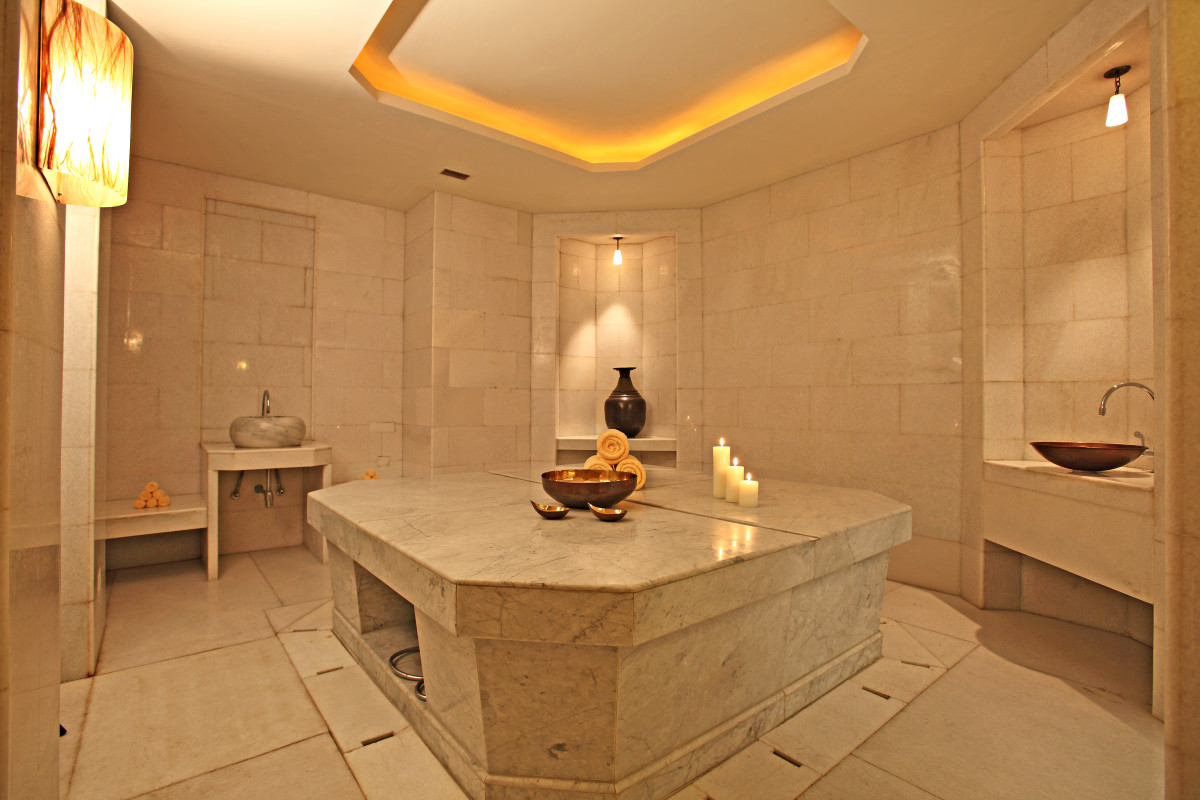
The Six Senses Spa at Jaypee Greens has turned its facility into a destination in itself. Aside being the largest and most luxurious of all Six Sense Spa properties, says Poole, “what’s interesting about this 3-floor, 90,000 sq. ft spa is the combination of interesting themes, décor and spaces that are tailormade for holistic wellness. Be it the Techno Gym with its innovative Kinesis apparatus, specially-designed retail therapy corner or state-of-the-art wellness studio that has a hamam, Watsu therapy centre and the ayurveda floor.”
For Roy however, a good spa is one that scores on aesthetics. “A zen-like design is imperative for any spa, as a peaceful surrounding only can lead an individual to reciprocate to any treatment and make it effective.” Given that Mandara Spa becomes a holiday spa vacation for many, Roy reveals that it was designed according to a Thai Balinese theme by Philip Fowler, a protégée of the famous architect Geoffrey Bawa, who ensured that there is ample sunlight in every room, with a pleasant landscape in the outside and wooden warm interiors.
Gowda agrees with the concept of good interiors. “A calming ambience goes a long way to make a spa experience memorable, and also increases the chances of guest’s turnover. But along with great interiors, a good spa needs flexibility, where a treatment can be made shorter or longer keeping the guests schedule in mind.”
Of course privacy, expertise and attention are the unsaid rules of a good spa. But those aside, Kumar believes that spa loyalty is garnered through holistic experience and attention to details and a knowledgeable staff who is skilled enough to satisfy guests’ query. Poole calls it “regular upgradation. Spas need to evolve to newer technology and human skills to keep it from disappearing.”
Clearly, when having a spa is not a novelty, one that renovates and innovates to its guests’ need and patrons’ expectation becomes the secret to success. Then, says Chetterjee, “having a lucrative price tag and interesting schemes becomes the icing on the cake!”
Evolution and design journey of a Spa
(NULL)

SHARE