

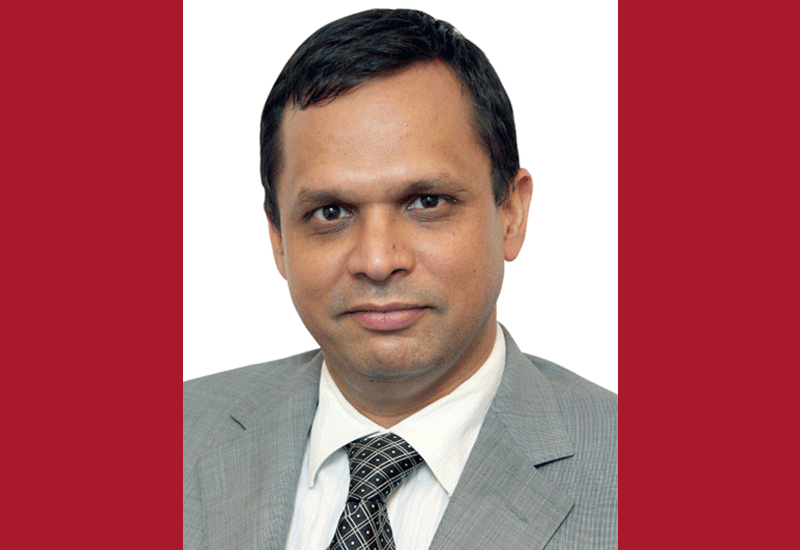
Sahara Star, despite an incomplete façade, does good occupancy, high rates and continous F&B business. It also has growing competition, across categories, within the stretch leading to Mumbai’s domestic airport and as such location alone cannot be credited for its success. Read on to find out what keeps it successful.
As the head of strategy tell us what thumb rules you have employed to keep Sahara Star’s rates and RevPAR at a good level, and F&B outlets always buzzing, despite the fact that the exterior is yet to be a gleaming jewel as expected? While you do have the benefit of location… but what else?
The analysis of STR figures has lead to the conclusion that Sahara Star has highest RevPAR (Revenue Per available room) of Rs6,850 as against competition set’s Rs5,100.
This achievement is a blend of various factors like dynamic pricing, global penetration through WorldHotels, a top listing on online travel agents like Expedia, flexible RevPAR-based rate offers, value for money, customised promotions depending on the season, our services and of course, our focus on providing guests with a multitude of dining and entertainment options.
Give us an idea of your distribution strategy? How are you working towards increasing direct sales?
Many hotels rate their success by their occupancy levels or average rates, but this isn’t necessarily the best measure of success. Our aim is to maximise RevPAR by selling rooms to the right customers, at the right price, at the right time. Today’s guest is information savvy and they no longer differentiate between media channels and content formats. The convergence of media channels has lead to the emergence of one single customer engagement channel. This new channel demands a completely new approach to hotel marketing and distribution. Mastering the direct online channel and all of its segments — traditional Web, SEM, SEO, email, social media, mobile Web — has been a crucial step in this direction.
What should owners and operators look for in their strategy managers in the hiring, promoting and grooming process?
Look for people who understand that strategy management is a science of calculation that gradually develops into the art of managing revenue, occupancy and ARRs. Ensure that they have an interest in and like to stay informed about industry trends and policies.
In your previous role at Hyatt, you were responsible for energy costs — between 2004 and now in 2012, which areas of energy saving do you think the industry continues to ignore/lack a focus on?
The hospitality industry is starting to take responsibility for environmental sustainability. A strong focus on energy, waste and water usage is directly linked with financial benefits in the operations. Practices connected to social aspect of sustainability are less developed. The economic driver has become overpowering. Companies include sustainable development in their strategy — as long as the benefits are visible. A broad definition of sustainability is needed and more attention should be paid to the different stakeholders.
You’ve been involved with lots of pre-openings…where are the gaps? Is architectural talent (that is well-versed with hospitality projects) available in the country or would you go elsewhere? Are you happy with interior design talent in India?
International architects definitely have an edge when it comes to master planning large-scale projects as they have more experience. However, in terms of understanding customer needs, market trends, products and pricing, Indian architects are comfortable. Interior designers need to become more flexible. Every design in the hotel industry needs recall and a ‘wow’ response from the user.
As an industry veteran, where do you think are the loopholes in terms of sourcing, motivating and retaining staff?
Attracting, recruiting and retaining key employees over the long-term will require both stimulating and challenging job opportunities within a company as well as creative compensation programmes. Properly designed, long-term incentive plans will help motivate employees to invest their efforts in longer-term business goals and objectives of a company. These plans can create an environment whereby the goals of shareholders and key employees are congruent and focused on improving business value. A great plan will allow the shareholders to view management team as business partner rather than employees and may lead to attracting and retaining key employees for many years.
How is the market as compared to the recent years?
The Indian hotel industry is currently on a weaker note with subdued pricing eroding margins. Muted ARRs and high costs have led to one of the weakest performances in recent years. With uncertainty continuing to cloud the near term, wavering business and consumer confidence and a sluggish economy, there is no significant trigger for an increase in rates. However, we remain optimistic on long term growth: improving demographics and rising affluence within the country plus under-penetration in the Brazil, Russia and China markets represent opportunities for us. Over the medium term we expect a structural change, with supply in the industry diversifying across price points. Further, with the entry of international brands in the economy segment standardisation of product offerings is expected. The market is expected to move towards a sustainable value-for-money proposition.
Your top five tips to revenue managers on working your own rates upwards in a way that is sustainable to the industry at large?
Successful revenue management, an understanding of what the hotel hopes to achieve and a clear understanding of what kind of hotel you are working with, will lead to an understanding of what the guest wants as a hotel experience. An ability to measure group sales against the overall goals of the hotel and a knowledge of what will cause the market to fluctuate is important. The distribution strategy must be dynamic.
Managing and marketing your own website should be your numero-uno priority but not at the cost of excluding other distribution channels. Your website should generate the highest yield compared to any channel, but other channels can give access to markets that might be otherwise difficult to access. Be market specific to take account of the fit between product, market and market share. Have relevant pricing strategies — to suit both offline and online channels. Consider internationalisation of your website for relevant overseas markets for language, currency, imagery and search engine optimisation. Managing inventory across a number of channels takes time and commitment. Allocate time each day or set aside a day each week to manage online distribution by using an online channel tool. While being dynamic, make sure to maintain rate parity across all online distribution channels as the internet makes pricing transparent and guests don’t like the idea that they may be charged more depending on where they buy. But to shy away from dynamic pricing — remember, the same guests are comfortable with price fluctuations when they book air tickets.


