

The first time that Biraja Rout tasted burgers was while working at Infosys in Bengaluru. So awed was this software engineer by its taste that he would commute almost 17 kilometres to satiate his craving to dig into it. Over time, he realised that indigenous burgers lacked authenticity and health quotient as they came with fried patties. He discussed his disappointment with Sandeep Satpathy and Abilash Bellur and the trio decided the country was ripe for authentic grilled burgers.
Recalling this journey, he stated, “Firstly, there was no Indian burger QSR back then, and home-grown QSRs sold Indian cuisine extensively. Although big burger chains dominated the market, there was a clear gap between the authenticity of burgers and what these chains offered.” This prompted him to set up a kiosk in 2011 to offer authentic grilled burgers under the aegis of Biggies Burger. Following its success, he set up the brand’s first store in 2013 and launched its first franchise outlet a year later. But the going was not as easy as it appeared. During the three years he turned an entrepreneur, Biraja did not earn a single rupee.
“However, I received lots of consumer appreciation, which gave me confidence that the brand would survive,” he stated. This assurance is validated by the daily sales report – when he started, Biggies Burgers sold 32 burgers daily, and today, it sells over 5000 burgers per day across all outlets. And when the offers for franchises began trickling in, he knew that consumers were accepting the product and the concept. “I was once preparing burgers at the kiosk at Bengaluru’s Electronic City since my employee was unwell. One of the regular customers inquired about the franchising opportunities thinking I was an employee at a franchise. This stoked the idea for taking the franchise route to grow the brand,” he said. This move also helped Biggies Burger expand beyond Bengaluru to cities like Bhubhaneshwar.
Ask him the secret sauce for his success, and Biraja claimed it was because he understood exactly what the market needed since he looked at it from the lens of a customer’s expectations. For instance, he noted that they sought a custom planned menu that catered to varying tastes and preferences that shifted from region to region. “Our outlet in Gujarat and Rajasthan is 100% veg while we have introduced fish burgers at our Calcutta establishment,” he explained. Similarly, the brand did not have milkshakes on its menu initially. However, based on customer feedback in select markets, it decided to offer this from 2018 and is now adding desserts based on consumer suggestions.
SMART PROCESSES
The key to any successful QSR is the consistency of its offerings. This can get compromised when there is human intervention – the French fries could be less firm or too crispy, and the burger to bun ratio might misfire. Biraja decided to deploy IoT-based processes to ensure constancy in taste and quality across the chain and eradicate these issues.
“A machine won’t function incorrectly unless it is fed incorrect information,” he explained. “Using IoT has helped us manage quality, scalability, sustainability and consistency across the chain.”
Today, some of the QSR chain’s outlets have automated fryers for fries and burger patties along with e-pans for wraps. Recipes are uploaded on the cloud so that the kitchen can deliver burgers with uniform taste across its entire network of stores. This efficient use of IoT has also helped the company reduce its dependency on manpower and better utilise time and staff strength.
“One key advantage of integrating IoT at our kitchens is that we could reduce Kitchen Preparation Time (KPT), which is a significant factor in shaping consumer’s choices in the QSR business. Every time a customer wants to place an order, they consider KPT, which is how fast a QSR can deliver the food,” Biraja clarified. Using automation, Biggies Burger brought down its KPT from 21 minutes to around 9 minutes. In fact, Biraja claimed that the brand has achieved 4-5 minutes compared to the average industry KPT, which has improved its customer acquisition and increased sales by around 30%.
MODIFICATIONS DURING DOWNTIME
The Indian food services industry was valued at around INR 4.2 lakh crore in FY20. While MNC players dominate this space, the past few years saw many new players enter the fray. However, a majority fell by the wayside soon since this industry has high operational overheads and minimal customer loyalty.
Aware of this, Biraja decided to opt for a chef less concept, which reduced a significant portion of direct cost. “We don’t have kitchens; we have assembly points. And these are operated by people who can read English, which helps them cater to varied customer demography. Moreover, the cost of everything – electricity, power or gas – is fixed, ensuring minimal wastage,” he elaborated.
When everything went virtual during the pandemic months, the brand underwent its most extensive rework. Research and Development was undertaken to improve the menu’s relevance to changing customer demand, and the staff was trained to improve their behavioral skills and knowledge base.

The company also recast its product design formula and menu customization during this period. One observation was that while most customers were ordering-in rather than visiting the store, not all products could be delivered. “Hence, we designed more delivery-friendly products,” Biraja explained. “For instance, we have a Cheesy Beast Burger with lots of cheese within. If we deliver this burger, the cheese gets hardened as it takes time to deliver, so the menu was altered to avoid this.
“He claimed that this pivoting comes easier to smaller businesses, which can introduce changes faster than their mightier MNC peers. “Moreover, whena larger company effects change, it is likely to become a costlier affair than smaller brands that can do it at lower costs,” he pointed out.
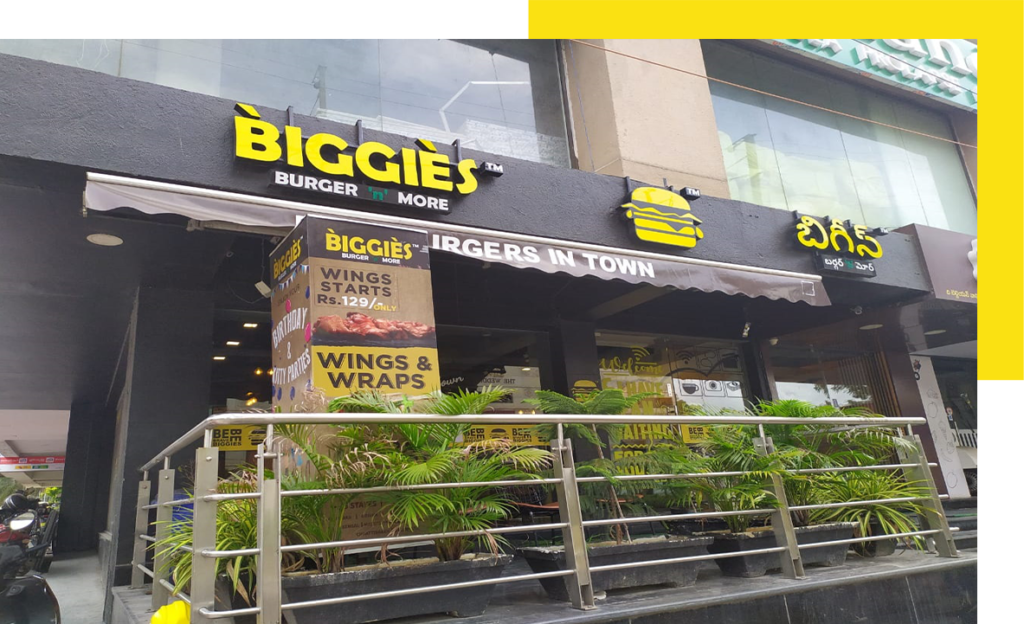
Today, Biggies Burger has 71 outlets, of which 43 are operational, and 25 are under construction across 26 cities in India. Biraja hopes to have 306 outlets by December 2024.
“There are many Indians overseas who want to bring national brands to their country of domicile. Hence, we hope to expand to two other nations soon,” he stated.
A techie turned foodie turned entrepreneur, Biraja has come a long way. He has successfully fused his love for burgers into a successful QSR chain, which recently received an undisclosed investment to further Biggies Burgers’ growth. But through this journey, one thing has stayed constant, his love for burgers, which he still enjoys with relish, especially those grilled to perfection at his own outlets.

