
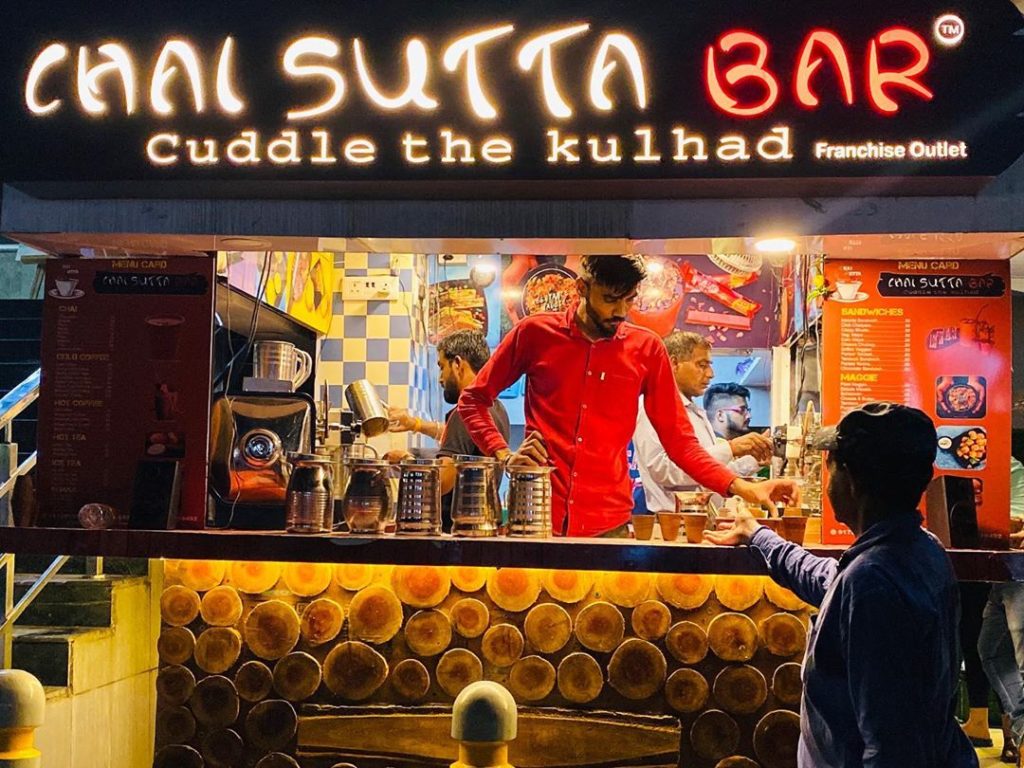
Growing up in Indore, sipping piping hot tea from an earthen cup or kulhad was a common social ritual for Anubhav Dubey. And why not? India, after all, is the second largest tea-drinking nation after China. However, Dubey still prefers to call it chai, rather than its Anglicized term.
So passionate was he about the brew that at a time when international coffee cafés were gaining popularity across India, he chose to open a kulhad tea outlet in his hometown. He reasoned that since it is amongst the most widely consumed drinks globally, surpassed only by water, chai is a promising product in the F&B industry.

Anubhav Dubey, Founder, Chai Sutta Bar.
“You can’t replace chai with any other product. So, it is not fair to say that any tea or coffee brand is our competition,” he explained. “Chai Sutta Bar aimed to serve quality tea at economic prices along with an exquisite ambience to stand out in the market. Also, offering tea in kulhad is unique and has its own beauty. This concept worked beautifully for us, as it had the essence and feel of our ‘desh ki mitti’.”
Armed with just INR 3 lakh as start-up capital, Dubey launched the brand in a company owned outlet at Indore’s Bhawarkua in 2016. He was thrilled when the turnover for the first year touched INR 15 lakh. In 2019-2020, Dubey revealed that this figured stood at approximately INR 35 crore and INR 50 crore in 2019-20 and 2020-21, respectively.
He is also proud that within five years of inception, Chai Sutta Bar has over 145 outlets across 70 Indian cities as well as stores in the UAE, Oman, and Nepal. By end of this year, he hopes to venture into five more countries in addition to opening 45 new outlets in India.
LEAPS AND BOUNDS
This rapid expansion was possible since the brand relied on franchise model. What is interesting is that while the F&B industry was literally gasping for breath since the lockdown was imposed last year, and even after it was lifted, Chai Sutta Bar’s franchise network was better insulated from major impact.
“After the lockdown, we almost tripled our franchise sale. We still sign up around five to six franchises every month,” Dubey claimed. However, he admitted that dine-in and kulhad sales figures definitely saw a visible drop due to the lockdown.
This has reiterated his belief that franchising will remain a viable business model for those who want to get into the F&B domain, even in the post-COVID world. The primary reason is that it is amongst the simplest trade form that an entrepreneur can implement and accelerate for rapid business growth.
“This model has no viable competitors. Our franchise programme clubbed with royalty helped us grow exponentially even during the pandemic,” Dubey stated. He added that in 2021, the company aims to come up with five new self-owned Chai Sutta Bar outlets as well.
KEEPING UP THE STANDARDS
With an ever-growing franchisee network, ensuring that partners diligently follow company policies related to pricing, packaging and staffing is essential to prevent any brand dilution. The tea chain’s R&D team is, therefore, tasked with warranting that every outlet meets certain defined standards and criteria, which includes location, staff hiring and pricing. Similarly, the company’s Franchise Action Team (FAT) conducts on-site inspection of these outlets from time-to-time to keep a watch whether its partners follow mandated protocols.
Dubey clarified that while this approach might appear to be a tad autocratic, it is actually designed to help franchisee partners. “Both teams deal with difficulties that franchise owners present to them and eventually try to resolve them. They also take reviews from customers to ensure that everything is working according to the norms set by the parent company,” he explained.
To avoid these issues from cropping up in the future, whenever Chai Sutta Bar engages in discussions with a new franchise owner, it keeps a margin to makes certain that all basic requirements and parameters are fulfilled. This is to maintain the economically viability of the retail store, by keeping manpower costs, rent and cost of kitchen space low, which can in turn boost profitability.
The average profit turnaround time is approximately seven months from the day the franchise is functional and Dubey claimed that not a single of the brand’s outlets till date is running below break-even.
MONEY’S WORTH
Most franchise businesses in the F&B sector outsource manufacturing of their menu items as well as business components to a centralised entity to reduce operational cost. However, Chai Sutta Bar has chosen not to go down that route. It manages the production of the kulhads, in addition to everything else, from its HQ to avoid compromising product quality in a bid to save money.
“We believe that profitability comes by providing quality and consistency. It’s extremely crucial for us that nothing invariably lower profit margins for our franchise partners,” Dubey said, while explaining this stance.
India’s F&B industry has literally been on the ventilator since March 2020. However, Dubey asserted that Chai Sutta Bar’s franchise sales were unaffected extensively. Of course, there were unpredictable cash flow swings and the business was not in a position to earn profits at the pre-COVID pace.
However, with the latest unlock guidelines and eased dine-in guidelines, things are picking up. Few Indians can resist a cup of kulhad chai, come rain or shine. This fondness for their day cuppa is expected to buffet Chai Sutta Bar’s revenue and the profit of its franchise outlets.


