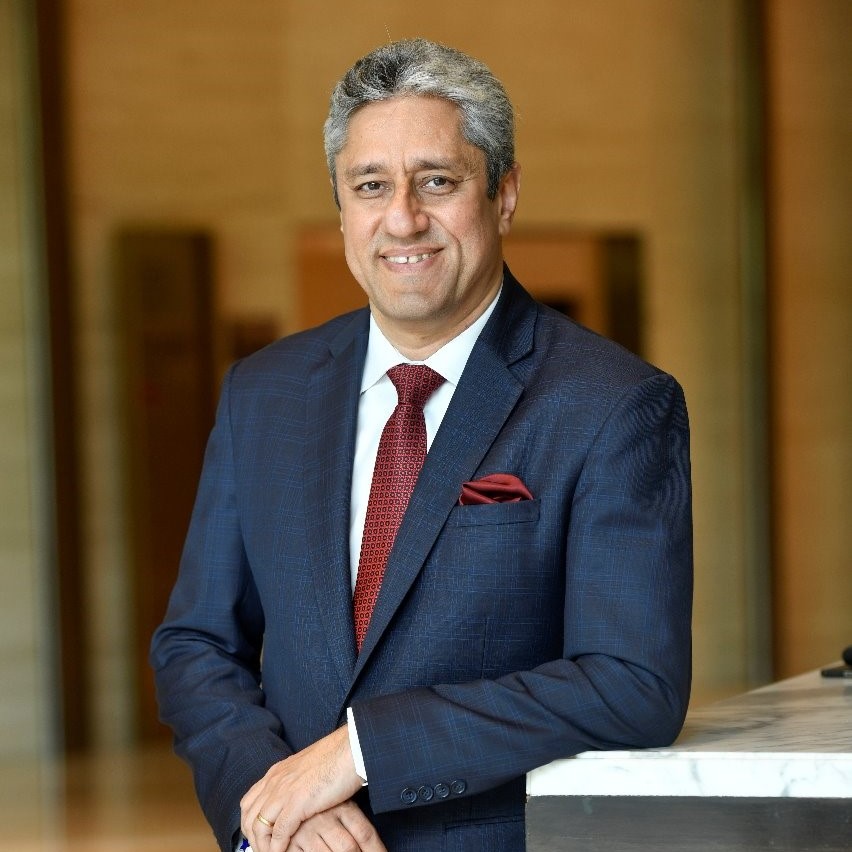
Jaideep Dang, MD, Hotels and Hospitality Group, South Asia, JLL, flagged off the discussion on ‘Acid Test – Caring for people, property and profits’ with a simple question – how did the recent adversity bring the industry together to make business more sustainable in the long-term. Sanjay Sethi, CEO of Chalet Hotels, pointed out that the collaboration that occurred in recent months was significantly missing in the past.
“The integration that happened in the past couple of years has not happened in the past five decades,” he added. “The solidarity that we see across the industry is phenomenal. We
could put our minds together to roll out recommendations to government agencies for mobilizing policy changes that will benefit the industry.” Jaideep then prodded the panelists to share the top three learnings from the pandemic pertaining to people, property and
performance. When it boiled to people, Anuraag Bhatnagar, COO, The Leela Palaces, Hotels and Resorts, claimed that the most significant realization was the need for communication. “During the pandemic, associates were extremely worried – they feared for their health, wellbeing and job security. It was imperative for leaders to show up, even if it is virtually, to assuage these qualms,” he stated.
The hotel chain used the downtime to revisit its CAPEX initiatives and decided to upgrade properties by investing in technology and strengthening distribution partnerships when it came to products. “On the profits side, we did not take too many dramatic steps since we are still in the growth stage,” Bhatnagar said.

WRITING A NEW PLAYBOOK
The most significant learning was transparency while communicating with owners for
Sudeep Jain, MD, South West Asia at IHG Hotels & Resorts. “There was no precedence to the pandemic, so we did not know what was going on,” he emphasized. “We built patience and confidence with the ownership community by telling them that let’s figure out the playbook together, which works mutually.”
He recalled how conversations kept changing as the situation unfurled. During the first wave, many owners were reluctant to take up quarantine business as they were worried that regular guests would not visit the property when business reopened.
“During the second wave, the same owners welcomed this clientele with open arms,” Jain recollected. “The reluctance disappeared within three months! Of course, this was on a property by property basis since there was no universal answer to the situation.”
Navjit Ahluwalia, Senior VP and Country Head, Hilton India, noted that it quickly became evident that everyone was in different boats as the weeks passed. “Each stakeholder has different equity debt issues. So, it became apparent that we can’t have one rule book for everything and everyone,” he claimed.
Ahluwalia added that Hilton had some strong owners who sought to support their long-standing associates, while other owners wanted to sack everyone in one night essentially! “We had to balance these two opposite scenarios judiciously,” he explained. “Since Hilton itself is a strong organization, which has always been pro-people, today it has become a far efficient entity that is well regarded globally.”

THE ART OF EMPATHY
The biggest insight for Accor was the need for empathy. When no one knew how to deal with the pandemic or ways to slam the brakes on slowing business, the one thing that people would never forget is how any organization treated them.
Puneet Dhawan, Senior VP-Operations (India & South Asia), Accor recalled how the company announced a $200 million Heartist fund in April 2020 to help employees globally who were unable to pay for their basic sustenance. “In the last two years, we disbursed more than $1 million in India, benefitting around 3000 Heartists somehow,” he elaborated. “Of course, transparency and communication were important, being humane and having empathy was paramount.”
At the same time, Dhawan added that several tough decisions had to be taken, keeping owners’ expectations in perspective. So wherever possible, Accord focused on driving topline growth. This called for collaboration with industry stakeholders like airline and OTA brands to drive business into the hotels.

Sharing his perspective as an owner, Sethi pointed out that engagement levels at Chalet Hotels went up exponentially. “We became support systems for hotels – be it for brainstorming, acting as sounding boards or decision making,” he noted. When it realized that the pandemic would not be limited to China in 2019, the real estate company went for a hiring freeze in January 2020 and a variable cost watch soon after. This helped Chalet Hotels post positive quarterly figures in the following year.
During the past two years, hotel companies were compelled to become creative when attracting business – be it offering quarantine facilities to international travelers or accommodation to healthcare professionals. At the same time, they had to identify new and ancillary revenue streams like food and beverage delivery and virtual events.
This was also when hoteliers had to truly walk the talk as their relationships and integrity went through a trial of fire. Those who stood with industry partners and employees during tough times are now reaping the benefits of brand loyalty, respect, or higher credibility. Putting the money where the mouth is was probably the toughest lesson they learned, but this realization has become the bedrock for all business decisions.