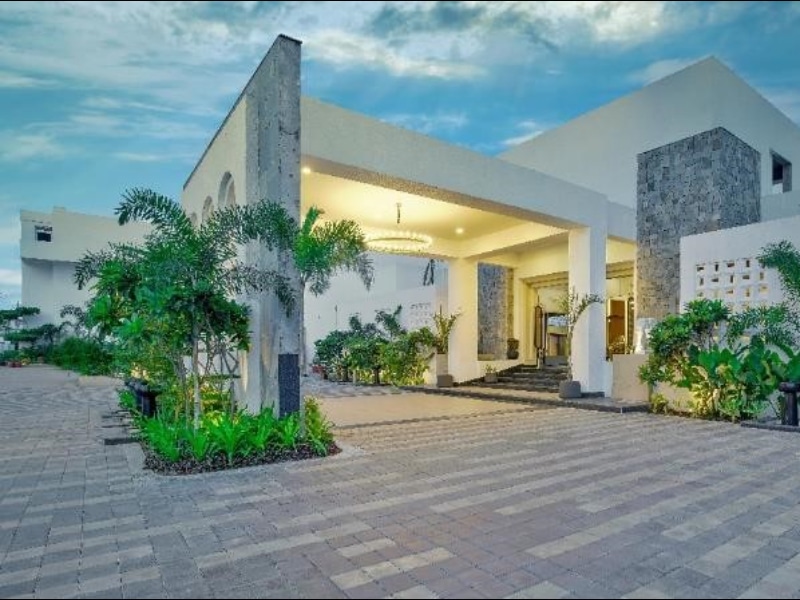
Since glass is 100% recyclable with minimal energy input, it satisfies most ecological parameters, besides providing an aesthetic touch to any space, says Sapna Kulshrestha.
The hottest trend in hotels these days is glass; it seems to be the material of choice for both designers and hoteliers alike.
Says Kishore Pradhan, landscape designer: “Glass creates a sense of space and brings an external environment within the building, which is why glazing the building facades now constitutes a significant part of contemporary hotel design.”
The most commonly used glass for external cladding is laminated glass. It is composed of two or more layers of glass with one or more layers of Polyvinyl Butyral (PVB) sandwiched between. Ideal for curtain wall glazing, atrium skylights, glass floors and roofs, it is also an excellent barrier to noise and ultraviolet light.
For example, at The Orchid Ecotel, Mumbai, architect DM Upasani has designed a hotel atrium skylight consisting of a laminated glass cavity dome that cuts off the heat load yet provides natural light to the space below.
Likewise, extremely strong tempered glass derives its strength from compressed surfaces and is used in both exteriors and interiors such as spandrels for walls, glass railings and handrails, where strength is important.
Another type of tempered glass is heat strengthened glass which has been strengthened thermally to provide the necessary resistance to heat building up; it is often used in complex glass combinations like double-glazing.
On the other hand, insulating glass or the double/triple glazing is a prefabricated unit made of two or more glass panes, separated by a cavity with edges hermetically sealed together. It is often used for hotel room windows and curtain walls as it is ideal for buildings with exceptionally high heating and cooling requirements.
Says Akshay Gavai, chief environmental officer, The Orchid Mumbai: “The triple glazed window not only blocks the heat of the sun from entering the room but helps in conserving air-conditioning energy too.”
Newer versions of external glass in a number of shades are offering enormous flexibility in the designing of hotel buildings. An attractive glass that has opened up new dimensions is the ceramic printed glass also known as silk-screened glass for its appearance. When assembled into double-glazed and laminated units, it combines aesthetics with solar control.
With sustainability being a big concern for hoteliers, there are novel forms of eco-smart glass now available. Reflective glass with metallic coating on one side significantly increases the amount of reflection, thus allowing daylight transmission inside the building yet reducing the heat gain and glare.
The latest dual-action self-cleaning glass with titanium oxide coating ensures break-down of organic material, keeping itself clean on its own and considerably reducing the maintenance costs for a hotel.
Glass also has the uncanny characteristic of making the simplest designs look breathtaking in the form of ornamentation, furniture, light fixtures, dividers, partitions and wall panels.
This is evident in The Park Hotel, Kolkata, where the bath is separated from the room by a curved glass black lacquered partition, or A.Z.U.R – the transition lounge at Goa Marriott Resort, where, says Elton Hurtis, director F&B: “The combination of unique features like frosted crinkled glass with LED lighting successfully creates varied ambiences.”
Some of the popular varieties for interiors are clear glass with crystal like quality, tinted glass that gives coloured light; patterned, figured or rolled glass that’s translucent with a decorative pattern emanating diffused light; and etched, frosted or sandblasted glass.
Glass blocks and stained glass are widely used in interiors as dividers and wall panels. Other trendy options include tiny glass tile mosaics for walls and floors, as finely exemplified in the glass mosaic peacock motifs embellishing the walls of the Mayur Mahal suite at Taj Lake Palace, Udaipur.
Says Nidhi Verma, manager PR and communications, The Claridges Surajkund: “The spectacular brightly colored blown glass mural by Rashmi Uday Singh in our Art Lounge has become the focal point of the entire lobby.”
Saint Gobain Glass India Ltd
Says R Subramanian, director, sales and marketing at Saint-Gobain Glass India Ltd: “Among our range of interior products, the latest is Planilaque Evolution, a rich-textured lucent glass, which merges the qualities of its different colour tones with the shimmer and grace of glass to produce a pleasing finish.
In different lighting conditions, Planilaque brings out diverse effects, thus creating a monotone-free setting. In addition, this interior glazing product is available in eight different colours and various thicknesses that makes the product customisable and ideal for cladding pillars and wall cladding in the common area of a hotel, as well as over the lift doors.
For instance, at the Hotel Metropolitan Cochin, SGG Planilaque Evolution embellishes the reception counter, giving it a refined and contemporary look.
Other novel products include patterned glass such as ‘Master Glass’ and ‘Baldosa Grabada’ that are ideal options for restaurant furniture and mini bar counters, as well as basin counters.
‘Diamant’ and ‘Décor Glass’ are valued for their optical clarity and visual brilliance and are best suited for glass staircases, doors and partitions in hotel lounges, while ‘Satinovo Mate’, a translucent glass with matte finish and a marvel in glass etching, is mostly used in guest rooms for shower cubicles, imparting a teasing effect of partial visibility.”
Palladio Glass Ltd
Says Tejas Shah, area manager, marketing, Palladio Glass Ltd: “Glass tiles allow the designer an unbelievable palette of colours and textures, creating stunning visual effects covering most hospitality needs.
They are also increasingly being used as decoration of wall surfaces in the conference area lobbies as it inspires magnificence and grandeur in interiors. Other common areas of applications are lobbies, restaurants, coffee shops, discotheques, and jacuzzi and spa rooms. Some of the hotels using our products are Le Meridien, Mumbai; Ramada Powai and The Park Hotels.”
While hotels are using glass tiles mostly for swimming pools or bath shower area walls, they are now applying it on the building exterior as well to create stunning glass architecture for outdoors.
For example, at The Park Navi Mumbai, the poolside space is characterised by a huge abstract Palladio glass mosaic pattern. Hotel sources at The Park Navi Mumbai agree that the colourful glass tiles wall in blues, grays and oranges create an abstract backdrop for the black elliptical pool, creating a signature space.
Emphasising the advantages of the 2×2 centimetre glass over conventional products, Shah says: “These light weight mosaics can be easily fixed on any surface and are especially suitable for curved surfaces like columns.
Further, they are maintenance free, in addition to being water, acid and fire proof, and retain their attributes for years to come even under harsh weather conditions. Also, the presence of avventurina and enamels enlivens the environment with strategically located lights.”
Windorz Façade Engineering
Says Rajeev Jain, director, marketing, Windorz India (P) Ltd – providers of curtain walls and glass façade systems: “Most of the hotels are using energy efficient glasses for their façades, more so, specialised glass such as heat reflecting or solar control glass that is now available in various shades, offering designers and architects more freedom in designing.”
The choice of glass would also depend on the specifications as well as aesthetic requirements of the hotel.
The use of double insulated glass has become very popular due to better thermal and sound insulation requirements of most hotels. Besides, as per the surrounding sound levels, advanced glass combinations can be designed to achieve the required sound insulation such as choosing from various options in insulated glass and/or laminated glass combinations.
Use of acoustic films within glasses is also an effective way of ensuring better sound insulation. Talking about some of their hotel projects Jain says: “While Crown Plaza Hotel in Gurgaon has a combination of fixed windows as well as double glazing, at Jaypee Palace Hotel & Convention Centre Agra, we have covered three pavilions with stick type curtain wall system with double glass in the vision areas and marble in the spandrel areas.”
Architect Rajinder Kumar of Rajendra Kumar Associates, designer for The Grand New Delhi, says: “There are Windorz double glass windows installed in the rooms with 47-millimetre thick glass, to reduce sound coming into the rooms from outside.
Patch fitting and framed doors for public areas and suites were made with 12-millimetre thick toughened glass while three glass-and-metal skylights in the lobby and two skylights in the porch were made in combination with laminated and insulated glass by Windorz.”
Sejal Architectural Glass Ltd
Says Nishit Jogani, brand manager, Sejal Architectural Glass Ltd: “Glass is extremely durable once processed or toughened. Our products for architectural needs comprises of the Kool range of insulating glass units (IGUs) for thermal insulation, uniform air conditioner cooling and savings in power, that help strike an optimum balance between transparency and thermal insulation.
They are used as external wall claddings, internal partitions and doors and windows. Tone Glass is the specially designed acoustic insulating glass unit ideally suited for noise control.
The units could be configured with high performance glasses to achieve thermal insulation with acoustic insulation for special requirements. In addition, Tone Glass with laminated glass provides safety, security, fading control and acoustic insulation.” Jogani goes on to say that Sejal architectural glass has been used at hotels like Sea Princess, Regent Hotel and Sun-n-Sand Hotel Mumbai.
Says Ritu Sadarangani, PR manager, Sun-n-Sand hotel, Mumbai: “All our hotel windows have been installed with insulating glass units that not only provide energy efficiency combined with transparency, but also sound reduction and security advantage.”
Besides architectural products, the designer series of Décor glass offers exquisite mirrors, panels, partitions and other furniture in exclusive and custom designed versions.
Gurind Glass Pvt Ltd
Says Rajeev Chandana, head marketing, Gurind Glass Pvt Ltd: “We cater to hotels in a major way; some of our prominent clients include Taj Hotels, Resorts and Palaces, ITC Welcomgroup hotels, Radisson hotels, Oberoi Hotels and Resorts and Trident hotels.”
Adds Manisha Sharma, assistant housekeeper, The Trident Gurgaon: “As the hotel is built around landscaped gardens and magnificent pools in the centre, all the interior spaces needed to have a clear view of the outside yet maintaining the interior comfort. That is why the large glass openings are insulated or double glazed with bevelled edges, to match the concept as well as control ambient temperature.”
Says Chandana: “The main types of glass used in hospitality are ‘Gurind Tuff-Toughened Glass’ for facades which can further be laminated for extra safety, and ‘Gurind Ceramic Frit Glass’, made by printing ceramic frit on float glass for glazing systems, shower cubicles, glass doors, and partitions in architectural interiors.
Heat strengthened glass is very popular among professional designers due to high impact, shock resistance and resistance to temperature differences properties. Furthermore, it is available in many colour shades to match the building exteriors. Gurind laminated and insulated glass are other popular products for the hospitality segment.
The decorative range consists of etched, bevelled, grooved and bend glass, in which sophisticated designs, variety of shapes and edge making is produced through computerised technology. Gurind tabletops in plain or decorative finishes and range of mirrors such as antique, bevelled and decorative framed mirrors are also being extensively used in hotel properties across India.”
Durall Systems India Pvt.Ltd
Says Sayed Haffiz, marketing manager, Durall Systems India Pvt Ltd, supplier for aluminum and glass architectural solutions:“High performance glass such as double insulated glass, low emission coated glass, heat strengthened or tempered glass and laminated glass, are increasingly being specified for use in glass facades. At the Peninsula Grand Hotel Mumbai, we have installed glass curtain walls for the façade that not only assists in creating and maintaining the right building environment, but is also safe and comfortable for occupants.
However, what is often overlooked is the role that framing systems play in achieving the specifications set by the architects or consultants for a project.”
Says Shreeram Tiwari, general manager, The Peninsula Grand Mumbai: “Our hotel is designed with 70% glass as building material. The glass facade gives the contemporary look needed for a business hotel also, since the glass is heat resistant and sound insulating, it works really well for the property given its location in the city centre.”
Adds Hafiz: “Our glass railing solution offers the uniqueness of a seamless glass rail while maintaining quality, safety and structural integration. The sliding glass panels are the best alternative for a concrete wall in terms of strength and thermal and acoustic insulation, where a seamless merging of the interior and exterior is desired for the hotel. Frameless glazing is another unique solution which is becoming popular in modern buildings, as it requires only perimeter interfacing framework. brackets and toughened glass.”