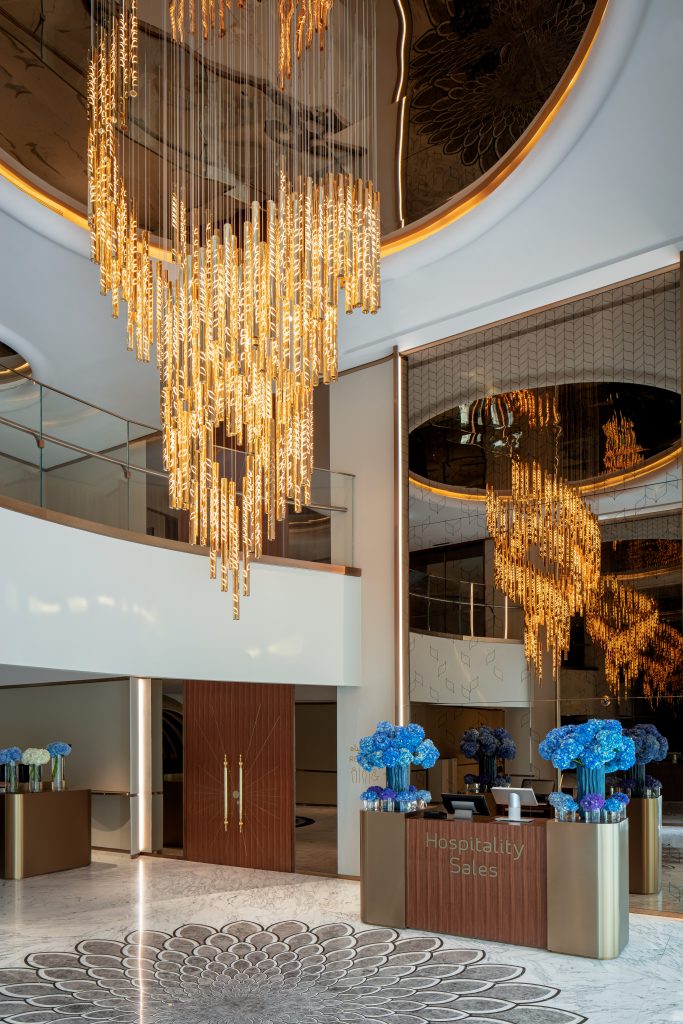
Sans Souci was established as a brand focused on bespoke lighting projects, and hospitality is definitely one of the key segments for us. Five-star hotels are always looking for unique lighting solutions, which is a great opportunity for us. We work with the architects and designers to develop new bespoke products and compositions to create special ambience for the end consumer. We start with a blank piece of paper or with an idea, a concept and the development of the projects can take years. So, hospitality is an exciting, but also long-term opportunity.
- What are the upcoming Trends in Luxury Lighting?
Lighting and real estate, together with other industries, have to address environmental issues, which are one of the key talking points today. We are looking for inspiration from nature, which is also connected to our wellbeing and health. This awareness has increased due to the pandemic. Being more considerate about our planet is also beneficial to us. This is a trend that we notice in luxury lighting.
Using natural materials and combining it with light, which is set up to boost the end-user’s energy levels during the day and calm him/her down during the night, is what we excel at. It’s a feat that can be accomplished while keeping the beautiful design as an added value.
2. What points are kept in mind while planning lighting for a hospitality project?
First of all, timing. They are usually big development projects, and they go through several changes at this stage, as there are many stakeholders involved in the decision-making process. This is linked to our business targets as usually these projects are time-consuming, but the return of the investment can take a couple of years. However, hospitality projects are very special as you get a chance to develop something new and large! The development and prototyping are very important as most of the items are produced for the first time.
3. How can a grand lighting plan elevate the interiors of a space and transform it into a luxury haven?
Today, you have many technological advantages and you can add smart lighting and use various innovative techniques to make the product unique. The light can react to music or movement and interact with the end-user to provide special experiences. It is about the aesthetic and quality of the piece and the artisan touch. But, most importantly, it is about the concept. You need to work very closely with all involved parties to achieve the desired result. The light and the chandelier need to communicate with the interiors as a whole and complement the other items in the space.

4. What are the challenges faced while designing a light for a specific project?
I think this is similar across the interior design industry and business in general. It is about the balance of time, budget, quality and innovation. Customers are keen to get things done fast, but have limited budgets. Limited budget always tends to compromise on quality. Our collections created from a number of components, need rich compositions to ensure great effect, but with limited budget, you need to decrease the number of components and the effect also gets limited.
Even when we look into history, the most unique projects in architecture and design we admire today were usually costly and took some time to develop, even when you were lucky enough to work with the creative minds and artists of that era.
The other challenge can be linked to the environment we design the lighting for. The yacht is very different from a hotel room, for example. And we have different regions with different environments and challenges, such as earthquake-prone areas, for example.
5. What is the role of innovation and technology in designing the new-age lighting for a project?
Smart home is for sure on high demand and all our lights are compatible with this technology. Also, we see that this can go much further. It started with turning the light on and off using automation, and today we are working and discussing the possibility of light acting as a fire alarm, and as a smoke detector! We know that the light can react to music, movements, temperate in the room and create various ambiences. We have a special team that works in the technology and innovation area, so we can focus on the design and incorporate the technology seamlessly.

6. What is the role of lighting in décor?
Lighting offers different perspectives, which can enhance the character of the space or highlight an art piece. Lighting is an important part of our lifestyles. Light allows us to see an object in different ways. Even in nature, as the light changes during the day, so does our perception of the space and time, and we can feel happier, energized or calmer, tired depending on the brightness of the sky. In our homes, offices or hotel rooms also light has the same effect. Light gives us the opportunity to create the place, and the piece is enlightened by light.
7. What is the difference between technical and decorative light? What impact does it hold on interior design projects?
Technical light has purely practical purpose. It is usually a simple light with practical function to light up the space. A decorative light can be an artwork whose purpose is to make the space beautiful. It can complement the technical lighting. It can be a pendant and have both the practical and decorative character.

8. Please detail the sustainability angle of lighting in the luxury interior projects?
There are many ways to look at it. It starts with the production. Using sustainable materials, recycling and working with the right suppliers, is one part of it. The production, its processes and the amount of green energy you use, as well as how you take care of your employees, is also important. There is no one solution and it is a complex set of decisions you make every day. Second part is when the light is handed over to our customer. It is up to him to save energy, use the best light source and ensure that the maintenance of the product is done sustainably as well.

9. Your take on the Future of Hotel design and innovations?
I think I have mentioned the key trends for the future, be it sustainability, new technologies, or the focus on wellness. It is about feeling safe in the space and being able to unwind and enjoy your stay. It does not matter if it is business stay or leisure. And lighting can for sure contribute to this as our minds react to it. We feel positive emotions when we experience something beautiful.