


India is gearing up for its biggest economic event of the year – the culmination of the year-long presidency of the G20 Summit. 43 Heads of Delegations – the largest ever in the G20 – will participate in the New Delhi Summit in September, which will conclude a series of meetings, more than 200, that have been happening across 100 different locations of the country.
And while they were on, every single host city and its venue put its best foot forward and left no stone unturned in making sure they gave the delegates – national and international – a time of their life. For the hospitality industry, the past few months have been nothing short of exciting and exhilarating. The industry which bounced back after the great dip, courtesy the pandemic, only received the much-needed power boost, courtesy G20.
Hotelier India finds out how exactly the G20 Summit is impacting the hospitality industry of the country? What kind of preparations have gone into making the events in each city a super success? And what does it mean for the future of the industry?

“Our ancient scriptures have a saying. ‘Atithi Devo Bhavah’ meaning ‘Guest is God’. And that is our approach to tourism. From transport infrastructure, to the hospitality sector, to skill development, and even in our visa systems, we have kept the tourism sector as a focal point of our reforms.”
PM Modi.
Hospitality at the root of G20
The motto of India’s G20 Presidency – ‘Vasudhaiva Kutumbakam’: ‘One Earth, One Family, One Future’ was beautifully captured in one of the Prime Minister’s welcome speeches at a G20 event in Goa: “As tourism ministers, handling a sector worth over two trillion dollars globally, it is rare that you get a chance to be a tourist yourself. But, you are in Goa – a major tourist attraction in India. So, I urge you to take out some time from your serious discussions to explore the natural beauty and the spiritual side of Goa!
“Our ancient scriptures have a saying. ‘Atithi Devo Bhavah’ meaning ‘Guest is God’. And that is our approach to tourism. Our tourism is not just about sight-seeing. It is an immersive experience. Whether it is music or food, arts or culture, the diversity of India is truly majestic. From the high Himalayas, dense forests, and dry deserts to beautiful beaches, adventure sports, meditation retreats, India has something for everyone. During our G-20 Presidency, we are organizing nearly 200 meetings in 100 different locations all over India. If you ask your friends who have already visited India for these meetings, I am sure that no two experiences will be alike.
“In the last nine years, we have placed special emphasis on developing the entire eco-system of tourism in the country. From transport infrastructure, to the hospitality sector, to skill development, and even in our visa systems, we have kept the tourism sector as a focal point of our reforms. The hospitality sector has great potential for employment generation, social inclusion, and economic progress. It employs more women and youth compared to many other sectors. I am glad we are also recognising the relevance of tourism sector for speedy achievement of Sustainable Development Goals. “The motto of India’s G20 Presidency, ‘Vasudhaiva Kutumbakam’ – ‘One Earth, One Family, One Future’ can itself be a motto for global tourism.”
That pretty much summarised the essence of the tourism and hospitality sectors of the country. And every hospitality partner city – Delhi, Bengaluru, Chandigarh, Chennai, Guwahati, Indore, Jodhpur, Khajuraho, Kolkata, Lucknow, Mumbai, Pune, Rann of Kutch, Surat, Thiruvananthapuram, and Udaipur – not only took this sentiment further but went above and beyond to ensure they made their G20 guests’ stays as incredible as possible.
Playing the Perfect Hosts

IHCL’s (Indian Hotels Company Limited) extensive presence all over India ensured that many of their hotels had the privilege of hosting the G20 delegates. Over 40 IHCL hotels in 23 cities played host. Says Parveen Chander, Executive Vice President – Sales and Marketing, Indian Hotels Company Limited (IHCL), “Our hotel teams have taken inspiration from India’s G20 theme – ‘Vasudhaiva Kutumbakam’ or ‘One Earth. One Family. One Future’. Each hotel customised the guest experience, drawing on the local culture, in many ways including unique traditional welcomes and drinks, delicious cuisine including specially crafted millet-based menus, branded amenities and entertainment. The hotel teams worked in close cooperation with the G20 teams to ensure that the delegates had a memorable stay.”
From the kick-off meeting hosted in Taj Exotica Resort & Spa, Andaman to the first Sherpa Meeting at Taj Lake Palace Udaipur and the prestigious catering at Rashtrapati Bhavan, each one has been a memorable experience, he adds.

| India & G20 |
| • India began its year-long presidency of the G20 in December 2022, signalling its emergence as a significant player on the global stage. As the largest democracy in the world, and the fastest growing economy, India’s G20 presidency plays a crucial role in building upon the significant achievements of the previous 17 presidencies. • The G20 group of 19 countries and the EU (European Union) was established in 1999 as a platform for Finance Ministers and Central Bank Governors to discuss international economic and financial issues. Together, the G20 countries account for almost two-thirds of the global population, 75% of global trade, and 85% of the world’s GDP. In the wake of the global financial and economic crisis of 2007, the G20 was elevated to the level of Heads of State/ Government and was named the ‘premier forum for international economic cooperation’. • As a nation committed to democracy and multilateralism, India’s presidency is a significant milestone as it seeks to find practical global solutions for the benefit of all. |
Believing that the G20 Summit enabled them to showcase Indian hospitality at its best, thus leaving a lasting impression on delegates from around the world, Zubin Saxena, Managing Director & Area Senior Vice President – South Asia, Radisson Hotel Group, says, “The Group has been actively leveraging their presence in tier 2/3 locations, such as Radisson Blu Ranchi, Radisson Blu Nagpur, and Radisson Khajuraho, to cater to the demands of the event. These hotels in key regional locations have become sought-after destinations for hosting G20 meetings and accommodating delegates. Additionally, our premium resorts, including Radisson Blu Udaipur, Radisson Blu Dharamshala, Radisson Blu Vizag, Radisson Blu Temple Bay, and Radisson Blu Pondicherry, have been highly preferred choices for hosting important meetings during the Summit. Their tranquil and luxurious settings have proven to be conducive to productive discussions and interactions. “Furthermore, we made sure that our conference facilities met the highest standards, with a minimum requirement of a 10,000-square-foot hall. Our hotels in Amritsar, Guwahati, Udaipur, Vizag, and Mahabalipuram are fully equipped to cater to the diverse needs of meetings, incentives, conferences, and exhibitions (MICE) events. Our experienced catering team, led by our esteemed Corporate Executive Chef Rakesh Sethi, curated a diverse and delectable menu, considering dietary preferences and cultural considerations.”

“The Group has been actively leveraging their presence in tier 2/3 locations, such as Radisson Blu Ranchi, Radisson Blu Nagpur, and Radisson Khajuraho, to cater to the demands of the event. These hotels in key regional locations have become sought-after destinations for hosting G20 meetings and accommodating delegates.”
Zubin Saxena.
Curating the Perfect Meals
Chef Julius Uttom Biswas, Head Chef, Evolve Back Resorts, Hampi, remembers sitting down for hours in the boardroom with the GM, OM, F&B Manager, and other HODs, brainstorming and visualising thoughts and ideas. Narrates he, “I remember the first day of recce at the ODC site at Shri Vijaya Vittala Temple (a world heritage site showcasing the musical pillar and the stone chariot). Hotels in and around the area had participated to get the opportunity to cater to the G20. It was a tough competition, but it is now a matter of pride and honour to get a ‘piece of the cake’.
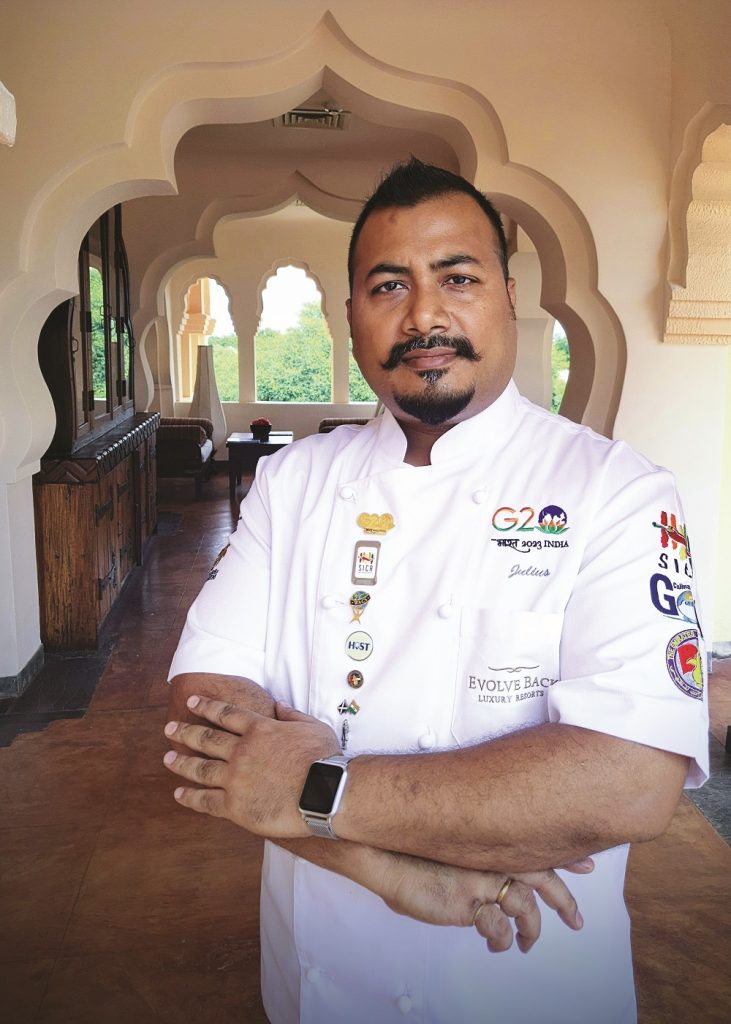
While it took months to collate and design the perfect concepts and menus, getting them approved by Indian Sherpa, Amitabh Kant, who is considered a food connoisseur himself, was a big challenge. “He guided my team and me towards a few inclusions from my hometown of Bengal. He was instrumental in our Grand ODC menu preparation around ‘The Glory of Vijayanagara’ which included research about food from the sacred ancient Hindu texts (such as the Mahabharata, Ayurveda, Srimad Bhagwatam, Manusmriti, Anushasana Parva, Bhojanakutuhala etc),” reveals Chef Julius.
Utmost care was taken towards initiatives to drive responsible tourism – right from the selection of alkaline eco-water to the usage of sustainable ingredients like millets, organic vegetables, fruits, and locally grown spices by our local farmers. “Though we were engulfed with challenges, frequent changes of opinion, and last-minute changes, our team spirit made the G20 event a huge success,” says he with a smile.

| Typical Influences of the G20 on a country |
| When a country hosts the G20 summit, it attracts many international delegates, Government officials, business leaders, media personnel, and support staff. This influx of visitors creates a surge in demand for hotel accommodations and related services. As a result, the Indian hospitality industry in the host cities may experience the following, according to Rajan Bahadur, CEO, Tourism and Hospitality Skill Council: • Increased Hotel Bookings: The G20 summit typically leads to a spike in hotel bookings as delegates and participants require accommodations for the duration of the event. This increased demand can positively impact hotel occupancy rates and revenue. • Boost in Business: The hospitality industry, including hotels, restaurants, transportation services, and event venues, may witness a surge in business. The influx of participants attending the G20 summit generates additional revenue streams for various businesses in the host cities. • Economic Impact: The G20 summit’s presence can have a broader positive economic impact on the host cities. It stimulates local businesses, boosts tourism, and generates employment opportunities, not only within the hospitality industry but also in sectors such as transportation, retail, and entertainment. • Infrastructure Development: To cater to the G20 summit’s requirements, the host cities often invest in improving their infrastructure, including transportation, connectivity, and conference facilities. These infrastructure developments can have long-term benefits for the local hospitality industry, attracting more visitors and events in the future. |
Abhishek Sahai, General Manager, Conrad Pune, tells us that meticulous arrangements were made to showcase the rich culture and heritage of Maharashtra, to leave a lasting impression on the delegates. He recalls, “The focus was not only to create a truly immersive experience that captured the essence of Maharashtra in its entirety but also to ensure that the true Conrad hospitality was in its forefront. A concrete security protocol was established keeping in mind the safety and security of the entire gala dinner for which the hotel teams worked very closely with the local police administration. The menu was carefully curated showcasing the ethnic diversity of Maharashtrian cuisine. Every dish was a true representation of the state’s culinary heritage, with the distinct flavors and spices that Maharashtra is known for.”
G20: Surge in Business
The G20 meetings held in different locations across India not only put the country on the global tourist map, but also augmented cooperation among Governments, the private sector, and various stakeholders to increase high-end travellers’ footfalls.
Adds Sahai, “This prestigious event has been a major opportunity for the Indian hospitality industry to grow. With delegates from across the world coming to India, the summit is an opportunity for the Indian hospitality industry to showcase its capabilities to the world. By providing a platform for international collaboration and networking, the G20 has put India on the map as a leading destination for business and tourism.”

Saxena, on the other hand, feels that the hospitality industry in India is currently witnessing a period of significant growth, driven by various events. The resurgence of corporate travel, MICE events, leisure travel, and the upcoming Cricket World Cup have collectively contributed to a substantial increase in demand for hotel rooms across key cities in the country.
“The business opportunities generated by India’s G20 Presidency have further amplified this demand, resulting in increased advance bookings in cities where G20 meetings are scheduled. Price is a factor of demand and supply, and, supported by these events, the demand for hotels has outstripped the supply this year, leading to a notable surge in room rates by approximately 20%,” he informs.

Seconds Chander, “G20 has been a demand accelerator across the country, positively impacting occupancies and average rates. The Government’s approach to organise the meetings in different parts of the country has provided an opportunity to showcase India’s diverse culture and heritage.”

New destinations in the North-East among others received a boost in tourism due to the meetings conducted there, all of which reinforce India as a MICE Destination for the future.
Vikramjit Singh, President, Lemon Tree Hotels, adds, “India is hosting foreign delegates for over 200 G20-related meetings in around 60 cities across India, which is the widest geographical spread in any G20 Presidency. Over 12,300 delegates, from over 110 nationalities, have attended G20-related meetings so far. As on date, 125 G20 meetings have been held in 41 cities, covering 28 States and Union Territories. These meetings have been held, across the length and breadth of India, with the support and participation of State Governments and Union Territories, and, due to the high demand, have helped to substantially increase ARRs (Average Room Rates) in different locations.”
Being the Ideal Travel Partner
Apart from hotels, travel companies too are doing their bit. Meera Charnalia, Executive Vice President and Head – MICE, Thomas Cook (India) Ltd, the company that has been empanelled as a key event partner for G20 Summit, says they were delighted to be a part of the event management team for the G20.
“The G20 represents a mega platform, and our MICE team has been involved with several aspects of the summit. Some of the areas under our control include airport assistance, enroute branding, and hotel assistance including setting up help desks, check-ins/ check-outs, distribution of gifts/ kits and transport coordination. Additionally, meeting venue assistance and coordination such as set up of meeting hall and meeting related space as per requirement, also overall branding in and around venue. We also enabled INR payments via UPI for foreign nationals from G20 countries – this facility can be availed across Thomas Cook’s airport counters and branches,” informs Charnalia.
The G20 Impact on the Future
India holding the G20 presidency provided an exceptional opportunity for the hospitality sector, as it led to an increase in international tourism, resulting in a surge in demand for accommodation, dining, and other hospitality services. This global event also allowed the country to showcase its diverse tourism sector, local arts, crafts, cuisine, culture, and infrastructure, especially in non-metropolitan cities.

“It’s important to note that the long-term impact on the hospitality industry depends on effective follow-up strategies and sustained efforts to leverage the exposure gained from hosting the G20 summit.”
Rajan Bahadur, CEO, Tourism and Hospitality Skill Council.
But how is it going to impact the future of the industry? Rajan Bahadur, CEO, Tourism and Hospitality Skill Council, elaborates, “The G20 summit is a major event that is likely to have a significant impact on the hospitality industry in India. The increase in room rates is just one of the ways in which the summit could impact the industry. The long-term impact of the summit will depend on how well the hospitality industry responds to the increased demand for hotel rooms.
Enhanced Reputation: Hosting a major international event like the G20 can enhance the reputation of the host city and country as a desirable destination for business, tourism, and events. This positive perception can attract future conferences, exhibitions, and high-profile events, leading to sustained growth in the hospitality industry.
Infrastructure Development: To successfully host the G20 summit, the host city often invests in upgrading its infrastructure, including transportation, accommodation, and conference facilities. These developments can have a long-lasting impact on the hospitality industry by improving the overall tourism infrastructure, last mile connectivity and attracting more visitors in the future.
Increased Tourism: The exposure and media coverage associated with hosting the G20 summit can increase awareness about the host city and country as a travel destination. This heightened visibility can attract a broader range of tourists, both domestic and international, resulting in increased demand for hospitality services.
Business Relationships: The G20 summit brings together world leaders, policymakers, and business executives, providing a platform for networking, collaboration, and business opportunities. The interactions and connections formed during the summit can foster long-term partnerships, trade relationships, and investments, indirectly benefiting the hospitality industry.
Skill Development: Hosting the G20 summit requires a skilled workforce to cater to the unique needs of the event. The training and skill development initiatives undertaken by the hospitality industry to meet the demands of the summit can enhance the overall skill set of the industry’s workforce. This can lead to improved service standards and professionalism, benefiting the industry in the long run.
Destination Marketing: The G20 summit offers an opportunity for destination marketing, where the host city and country can showcase their attractions, cultural heritage, and hospitality to a global audience. This exposure can contribute to long-term brand building and attract tourists and business visitors even after the summit concludes. “However, it’s important to note that the long-term impact on the hospitality industry depends on effective follow-up strategies and sustained efforts to leverage the exposure gained from hosting the G20 summit. The host city and industry stakeholders need to capitalize on the positive momentum generated by the event and continue to invest in infrastructure, marketing, and service quality to ensure the long-term growth and competitiveness of the hospitality industry.”
| The Big Boost |
| Zubin Saxena spotlights key factors indicating the upward rise in the hospitality industry: • With over 200 meetings taking place across 55 locations in India and an estimated 1,50,000 foreign delegates expected to visit, the country’s tourism sector is projected to make a strong recovery and return to pre-pandemic levels by mid-2024. • The Hotel Association of India (HAI) anticipates demand for over 3 lakh rooms during the G20 meetings, presenting a significant revenue opportunity of approximately Rs 850 crore for the hospitality sector. • Overall, the Indian hospitality industry is expected to witness a robust growth of 5.5% CAGR due to the impact of the G20 presidency. • Industry stakeholders are enthusiastic about capitalizing on this opportunity, catering to the travel and accommodation requirements of delegations, while also laying the groundwork for future growth. • This upward trend is expected to continue in the coming months, and industry estimates suggest that it will surpass pre-crisis levels in the upcoming quarters. |
For now, however, preparations are on in full swing in the national capital. Beautification of the Delhi airport roads, removal of encroachments from the footpaths, flower and food festivals, and more… PM Modi even performed a havan at the inauguration of the new International Exhibition-cum-Convention Centre (IECC) at Pragati Maidan, which will host the G20 Summit. Reportedly, a whopping Rs 2,700 crore has been spent on the development of IECC, which aims to promote India as a global business destination. With hospitality, undoubtedly, at its core…


