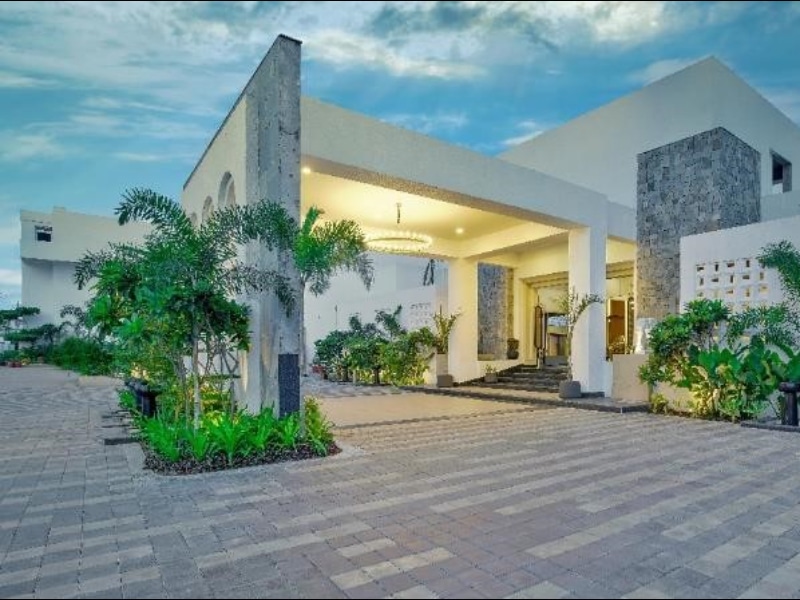
Soft-spoken and camera-shy, Arne Sorenson is the president and COO of Marriott International at a time of superlatives – the group celebrating its 35th year outside the US has opened its 500th international property in Pune, and is promising to deliver 100 Marriott hotels in the next five years. Hotelier India spoke to him on his recent visit to India.
Promising a century in cricket-happy India is a great move – when Arne Sorenson, president and COO of Marriott International visited India to open the group’s 500th property worldwide, he took time to announce expansion plans that would take the tally of Marriott group’s India properties to a 100 in the next five years.
“India is a great, growing economy and as that economy grows, its need for hotel rooms grows too. We’re excited to be here for obvious reasons,” says Sorenson, as he outlines how India is getting increasingly significant even though it currently houses only 11 of the group’s 3400 properties.
“We estimate that there are only about 140,000 hotel rooms in the entire nation of India today. That is smaller than the city of Las Vegas. It has the second-largest hotel development pipeline in Asia, and is expected to double the number of branded hotel rooms over the next three years to about 120,000 rooms,” he says.
He says he is thrilled that about 10% of those new rooms are slated to carry a Marriott International brand flag.
“We are opening our first Ritz Carlton in about 18 months. We’re particularly excited about the Courtyard brand, which has launched with tremendous momentum – there are five branded Courtyard hotels that have opened in the last 12-18 months that are doing extremely well,” he says.
Marriott International is looking at going to 20 in the next 12 months. The company has signed management agreements for seven new hotels in India, including five moderate-priced Courtyard hotels, one for the upscale Marriott hotel in Jaipur in western India and another for the lifestyle Renaissance property in Raipur in central India.
When all signed hotels are opened and added to the company’s portfolio of 11 operating properties and 23 previously announced hotels now under construction, the Marriott portfolio in India will total 41 hotels by 2013.
The last month has seen Sorenson busy in other parts of the world as well – on November 9, he was in London purchasing the Berners Hotel, with plans to turn it into a boutique Edition brand hotel.
After opening the 416-room hotel and convention centre in Pune on November 11, he was off to Brazil by November 17, announcing plans to boost Marriott’s Brazilian hotel count from four to 54, with 50 Fairfield by Marriott, in conjunction with Rio de Janeiro-based real estate developer PDG Realty. Whilst in India he also talked about doubling the brand portfolio in China in the next five years.
“One of the big areas of focus for us as we go forward is our global expansion. This year we celebrated the 35th anniversary of our first hotel outside the US, the Amsterdam Marriott,” Sorenson says.
In this region, Marriott has 130 hotels and 70 more under development. India and China remain two major growth areas. Other key growth areas are Thailand, Vietnam, certain parts of South East Asia, Malaysia, South Korea and Japan. Marriott International has 52 hotels opened in China currently, another 25 signed in the pipeline. Five year plans include taking the tally to 150.
By 2015, Marriott International plans to add more than 600 hotel properties, taking its overall global tally to more than 4,000 hotels.
“We have 615,000 rooms. We think globally over the next three years we should be opening about 30,000 rooms a year. The rate we have given is 80 to 110,000-room gross additions over a three year period of time,” says Sorenson.
These are new markets for Marriott International, which saw its beginnings in a root beer franchise stand in 1927 set up by Alive and J Willard Marriott in Washington DC. It was only in 1957 that JW “Bill” Marriott Jr and his father opened their first hotel. Sorenson is the third president of Marriott International.
The brand
In the US, the company has endeared itself by reliability and consistency – brand values that the soft-spoken Sorenson personifies. Marriott International has a reputation for being a great place to work in, where employees are promoted from within, reaching top slots after rigorous training.
Around the time that Bill Marriott’s blog announced the promotion of Sorenson to his current position of president and COO, in March 2009, the company was forced to eliminate some positions. Bill Marriott chose to forego two-thirds of his compensation during the year and all of the group’s senior executives took significant decreases in their compensation.
While Marriott has shown a turnaround in 2010, it has meant that emerging markets, happily skirting the recession, are being seen as more important.
In India, close on the heels of US President Barack Obama’s visit, Sorenson is happy to talk jobs. He announces that the expansion will create 8000 new jobs in the country in the next three years, underscoring that “talent” remains the differentiator in the brand.
“We’re already seeing that Indian employees of ours are quickly graduating into management ranks and increasingly they are taking leadership positions not only in our hotels in India, but in a number of our hotels outside India as well,” he says.
Based in suburban Bethesda, Marriott operates and franchises over 3,400 hotels in 66 countries, less than 10 of which it owns. Marriott operates about half of the rooms in its system, including most of the upper-end hotels, and franchises the rest.
India
Compare Marriott to other brands in India and Sorenson is quick to remind that Marriott’s India growth story is only 10 years old.
“We started in India just about a decade ago with a resort in Goa… We started the Courtyard brand 26-27 years ago in the US. We acquired Renaissance in the late 1990s [a year after Sorenson joined Marriott as SVP, business development].
I think the first stage for Marriott in India was that to get the Marriott flag on the map, to get the Renaissance flag on the map. And provide a place for our global travellers… That was the first toe in water in this place and now we are growing that portfolio of brands,” he says.
Marriott works with a number of partners throughout the country – in some places with real estate developers, in others with independent hotel owners who make investments. Marriott is now being seen in new emerging markets in India, in secondary cities which could not have taken big, branded properties earlier.
“We do everything with local partners. We look at real estate development. We are good at providing management expertise. Thus far we have real estate partners in India who are clearing the cost of real estate development. I suspect that as we grow forward we will put some equity stake but we expect most of it to be locally driven, locally owned,” Sorenson says when asked about owning hotels in India, as opposed to operating them.
Currently in India, 35% of Marriott’s portfolio is Courtyard, 28% of that portfolio is JW Marriott. The mother brand is expected to be there in most cities. Courtyard and Fairfield are capturing customer demand for more business related travel at a certain price level.
Mid-market and budget segments are the biggest gaps in India and elsewhere. “Certainly, if you look at the global perspective, Fairfield has grown most in the last five years, in markets that include the US and many others around the globe,” says Sorenson.
Asked if Fairfield will lead the growth in terms of number of hotels in India, Sorenson says, “Absolutely. We think we can have dozens if not many more Fairfield hotels in the next five years.”
Marriott is looking at about 75 Fairfield hotels in India in the next 10 years. Major metros will be home to more than one property. Despite not having a firm first Fairfield yet, Marriott has identified 90 cities in India that have strong business activities to justify their presence.
While India may not see all the Marriott brands at once, and China is not going to be introduced to a Fairfield soon, Marriott International operates hotels under Marriott, JW Marriott, Renaissance, EDITION, Autograph, Courtyard, Residence Inn, Fairfield, Marriott Conference Centers, TownePlace Suites, SpringHill Suites, Marriott Vacation Club, The Ritz-Carlton, Marriott ExecuStay and Marriott Executive Apartments.
Ask him whether so many brands won’t confuse the guest, Sorenson says, “We’re very deliberate about trying to minimise that confusion. Our philosophy is that we want to have the leading brand in each distinct segment of the travel market place. For any of us we stay at different levels of hotels depending on the purpose of travel – whether it is business travel, personal travel, professional travel, special occasion, whether with family or without family. We want to be there to provide a solution.”
Distribution
Multiple properties allow the company to harness the distribution system, with partners who don’t enjoy that advantage. It was this system that became Marriott’s USP in partnering with The Cosmopolitan, which opens on Las Vegas Strip this December.
The casino has a partnership with Marriott International includes a distribution agreement with the hotel company’s Autograph Collection, a portfolio of upper-upscale and luxury independent hotels and resorts, which provides access to 33 million Marriott Rewards members.
“By having a portfolio of brands we can get much more efficiency and power of our distribution systems with advantages of scale in procurement,” says Sorenson.
Luxury
Luxury, personified by Ritz Carlton, remains in focus too. Simon Cooper who headed Ritz Carlton for 10 years is now president and MD for Marriott’s Asia Pacific division. Amongst his triumphs is adding a Ritz Carlton in Tokyo three years ago, after a 15-year wait.
The first Ritz Carlton in India is scheduled to open in 2011 in Bengaluru. Cooper jokingly says that the answer to why Ritz Carlton does not have an India presence lies in two words, “Biki Oberoi”.
Bill Marriott is no less a legend. He blogs regularly and by September this year he had already toured 200 of his hotels in 20 cities. He confesses to being in the competitors’ kitchen more often than they realise and admits to sending back badly cooked lobsters, right back to the kitchen of one of his own upscale hotels.
While Mumbai and Delhi are hard cities to get into, in terms of land costs and availability, Ritz Carlton is scouting in these places.
“We will be opening our first Ritz Carlton here. JW Marriott is already the third-highest rated luxury brand in the world – Ritz Carlton being the first. And to add to our boutique product [Edition] with Ian Schrager and Autograph which is a collection of really fine hotels, you will continue to see that the portfolio as a whole builds in terms of awareness with the public,” says Sorenson.
City focus
Marriott already has three hotels in Mumbai – four if one includes the hotel apartments in Renaissance. Another property, a 160-room Courtyard by Marriott has been announced in Chembur. South Mumbai, home to the Taj and the Oberoi, in addition to Marine Plaza, Vivanta and Trident brands, remains elusive to the Marriott, despite the fact that the company is the largest operator of hotel rooms in Mumbai.
“One of the reasons we work with partners is to ensure that they have land already or they have access to the land,” says Sorenson.
Over years the ownership patterns for properties have changed. The trend of real estate players dominating hotel ownership space has slowed down. It is now replaced by a number of independent owners who may have other business interests. Sorenson says that about 35% owners in India are from real estate.
In India the gestation period for hotels is longer compared to some of the other international markets. Rising labour costs is faced across the industry.
RevPAR
Sorenson is reluctant to talk about RevPAR rates or sales, except to say that, “Globally it will be in high single digits.” Asia Pacific works differently from other parts of the world.
“Various parts of Asia will be affected by supply dynamics and unique events in single markets. I think we have a long way to go, to get back to 2007 levels.
In most markets of the world you will get back to 2007 levels, but it is likely to be three years before we get back to those levels. In India we have some markets, that not three years ago but four or five years ago, were trading the rates that were very high in part, because there was no supply,” he says.
Given that all international brands are formulating aggressive strategies, does Marriott enjoy an advantage, despite being a newer player? Sorenson says, “I don’t think it will surprise you that I am somewhat biased in Marriott’s favour. I don’t think in material respect we are trailing those companies.
The total rooms we have, is only one measure of the power of our portfolio of brands. When you look at revenues, we are skewed much more highly towards the full service side. The economics associated with our hotels are more significant.
If you look at the power of our brands, the way our brands command the market share premiums, we feel very good about the way we are proceeding. We have been in India only for 10 years. A number of our competitors have been here longer. We have got years ahead of us.”
Key trends for 2011
1. One of the trends is, hopefully, that we will see governments step up to make travel easier so that we see more and more of international travel. It is about opening more visa offices, faster processing, finding some decent way for persons in certain circumstances.
2. We should be ready to respond to the increasing number of leisure travellers. If we look at the last 10 years or so, leisure travel is growing faster than business travel.
Knowing sorenson
Arne M Sorenson joined Marriott in 1996 as senior vice president of business development. He was appointed executive vice president and chief financial officer in 1998 and assumed the additional title of president, Continental European Lodging, in January 2003.
In May 2009, Sorenson was named president and chief operating officer of the Company. Prior to joining Marriott, he was a partner in the law firm of Latham & Watkins in Washington, DC, where he played a key role in 1992 and 1993 in the distribution of Old MI by Marriott Corporation.
Sorenson serves on the Board of Regents of Luther College in Decorah, Iowa. He also serves on the Board of Directors of Wal-Mart Stores.
Compensation for 2009 from Marriott: $1,830,272.00
Prius
Sorenson drives to work in a Prius, whereas Bill Marriott is known to have a stable of Ferraris and Maseratis.
On Bill Marriott’s blog this November, the CEO talks about welcoming the new Chevrolet Volt, to the hotel for associates.
Sorenson at work? Perhaps. He is the co-chair of Marriott’s green council. In 2008, he launched Marriott’s rainforest preservation partnership with the Amazonas Sustainable Foundation in Brazil, committing $2 million.
Almost a year after Sorenson took over as President, Marriott International’s 30-year old headquarters building in Bethesda, Md, was granted the LEED Existing Building Gold status. Marriott currently has 40 LEED-certified or registered hotels and plans to have 300 by 2015.