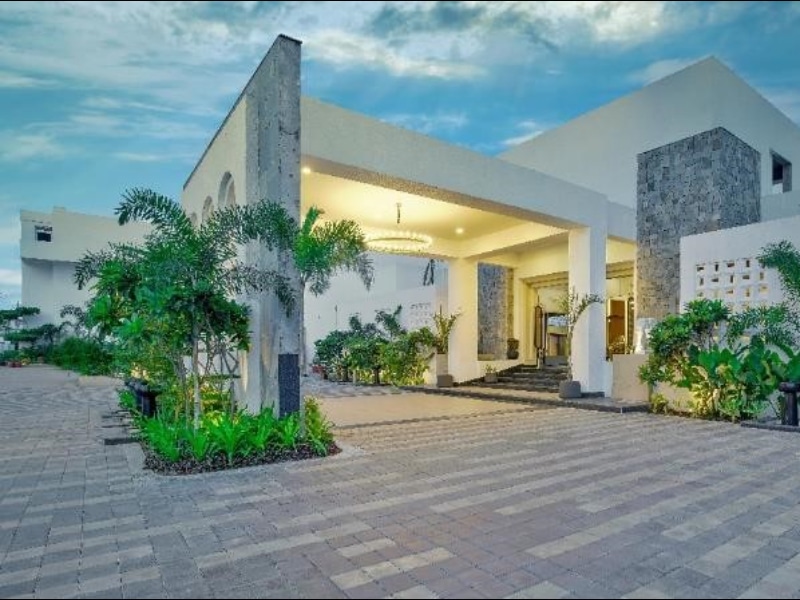

Sandeep Gupta, MD of Edenpark Hotels, promoter of Inovoa Hotels & Resorts and Executive Director, Asian Hotels (West) Ltd works with three brands – the Hyatt Regency, the Clarion and JW Marriott. He speaks to Hotelier India about expanding apartment hotels.
What are the future plans of Edenpark, Inovoa and Asian Hotels?
Gupta: Edenpark is the owner of one of the hotels, the first Clarion in the country, Clarion Collection, New Delhi, a 60 room boutique hotel with 30 serviced apartments.
Inovoa has signed a 20-year master franchise agreement with NYSE-listed Choice Hotels International for the Clarion brand. Hillwood Corporation USA, a Ross Perot Jr. company, holds 24% in the company.
IHRL has recently opened its first 130 room hotel property under its upscale Clarion Century brand at Whitefield, Bengaluru and has plans to develop a Clarion Hotel in Pune with an inventory of 100 rooms. Two more management contracts have been signed in Lonavala and Greater Noida.
Asian Hotels (West), which owns the Hyatt Regency Mumbai, is developing its second luxury hotel, a five-star deluxe hotel in Delhi, under the brand of JW Marriott, which will be operational by 2012. That will be a 525-room hotel with dining options, ballroom, health and spa facilities.
The company is looking at investing at least INR150 crore over the next five years to have around 10 Clarion-branded hotels across India. These include management contracts and developing hotels.
In addition, there is the Qutab Hotel bought from ITDC under the Government’s disinvestment scheme. We have turned a run-down loss-making unit to a successful, profitable venture. We bought it in 2002 and since then have fully renovated it. It is a 60-room property. It is now a profitable venture making about 40% GOP.
You were working with the economy segment of Choice hotels earlier. Why the change in focus now?
Gupta: Clarion is a Choice brand. But we have chosen to get out of the whole economy segment. There is growth there but the question is of returns. Land is very expensive. We did an analysis of locations left and did not find significant returns for the price of land, to suit us.
Even in Tier II cities, the brand which we have, will give us good returns. We’ll have good returns if we work on the basis of USD$150 ADR in multiple locations.
What are the challenges of running a franchise model in India? Which is better – being a management company or franchising your brand?
Gupta: Quality control is the biggest challenge. When you have badly developed products, the challenge is in control. Internationally, quality control is a stringent process.
They have a lot of systems in place. There are guest satisfaction programmes, which have not come into India at that level. Our battle was to put the money back into the property to upgrade it. It is a very slow process. We had to delete a lot of hotels.
In a franchise you constantly have to balance quality vis-a-vis growth. We have deleted the same number that we added. A lot of brand companies face different challenges. We’ve decided to focus on the key brand now. Management is the best way to support your brand. The hotel owner would employ all the staff. We provide the GDS, both from Inovoa and international systems.
You bought Qutub in 2002 from ITDC under the Government’s disinvestment scheme. How did you turn it around?
Gupta: We fully renovated it. It is a 60-room property. We’re making about 40% GOP in that. First, we changed the employee base. We trained the people, redeveloped all the concepts in the key areas.
The highlight was location; we introduced service apartments, very high end. That put us on the map. It was the only property to offer both long-term and transient options. We did a lot of marketing and promotions. We went to local events and promoted it.
What are the pros and cons of serviced apartments in India?
Gupta: Standalone service apartment model is a trade-off for a developer. He has to allocate more space. Trade-off is on the return on the build. For an operator like us, for a brand operator, it is different.
We look at filling gaps in the market where needs are different. It is not just a real estate play for us. It makes sense to provide for the long-term traveller under the same roof.
Some people have long-term requirements since they are looking at lower rates, they get more space.
The staff ratio is not lower or higher compared to a hotel. The service in the service apartment is more rather than less. Their requirement is higher. Our model is a different one. Our apartments are huge.
If you have someone staying long-term, adding another room would balance it out on the rate. Our Delhi property is very high end. Not typical in terms of what we charge. At the higher-end, hotels can charge USD$20000 a month and at the cheaper level you can get a serviced apartment for USD$100.
You are working with multiple brands internationally. Have you thought of consolidating your own brand?
Gupta: We do have an associate brand called Century – the first 130-room hotel under the Clarion Century brand has made its soft-launch at Bengaluru. We have a brand we have kept for ourselves for the future. We are in luxury, upscale and the four-star space with international brands. If we find a niche, we’ll work with our own brand too.
How do different brands work differently for you? You have Clarion, JW Marriott and Hyatt Regency.
Gupta: We have been associated with Hyatt for the last 30 years, then we associated with Choice for midmarket for 10 years, the new addition is the JW Marriott, because we wanted a luxury product in that location. We have been with both of these companies for particular segments.
And when we decided to do our first luxury hotel, we chose JW Marriott because brand recall in India is very high for it. We went back to Choice for Clarion.
You own, manage and franchise. What is your USP?
Gupta: Knowing that market, bringing international brands, having local knowledge, a long-term outlook and association are our strengths. We don’t work with one brand short-term and change it. I have been involved in various segments and I bring that on board. We adapt to changes in the market.
Name any three changes that you adapted to recently.
Gupta: One is guest satisfaction, which is what we have to adapt to. We adapted to personalise the experience. We mould the international brand to adapt to this. We are trying to make Clarion a lifestyle brand – value for money, chic looking.
In the long term stay segment, we learnt that it is easier to go through the troughs with guests. Clean energy is the latest initiative that we would like to adopt. We want to go green in all the projects.
Building a Greenfield hotel is said to be a challenge few can undertake. What is your view on changes this sector needs?
Gupta: I think the government has been fairly proactive. There is a huge inventory now in some places; you see a lot of midmarket hotels coming up in the location. It is true that no one can get free or cheap land but there are investment opportunities.
One has to be discerning in terms of a long-term outlook. What is needed is tax rationalisation across the states. There are a lot of good policies but between the states there should be rationalisation instead of having different tax regimes in different states.
Infrastructure remains a concern in cities such as Mumbai and Bengaluru. We have a national building code, which is applicable but local building codes are still prevalent. Our laws are not bad but they are not uniform across the country.
As an owner, what do you think is the best way of working with management contracts and franchises?
Gupta: If you get an international expert, you should let them do their job. You can concentrate on development and on financial management to a certain extent. They are bigger experts at managing.
You listen and learn. We have been successfully working with Hyatt. Some owners may have personality issues or something but we have had no challenges working with Hyatt.
Which cities are the focus of growth for Clarion?
Gupta: Two of our properties are already operational. We are working on a management, development model. We want to be in all the metros. We want to be in Chennai, Mumbai and Calcutta, in addition to our properties in Delhi, Pune and Bengaluru. We can consider Tier II cities but we are an ADR driven brand.
There is some noise about Pune getting an oversupply. How does it fit into your plans?
Gupta: We have not started construction yet. Our location is off the city, in Hinjewadi. And Mumbai-Pune corridor is a very exciting development. You will notice now that cities are becoming more fragmented. One city is a collection of four or five cities. In Pune, we are waiting for the market to mature until we start construction.
What are the three trends to watch out for?
Gupta: Green zones, obviously. There is also going to be more emphasis on lifestyle living. There will be more lifestyle brands that distinguish themselves alongside groups that are preferred. Lifestyle could mean anything for a certain set of people with a certain requirement. It is a creation of niche markets. There will also be far greater use of the extended stay market, India being the destination of many more expats.
What is the total investment you are looking at in the next five years?
Gupta: We are planning to invest INR150crore for Clarion. All 10 properties we are planning are not developed by us.
How long does it take to build a hotel in India?
Gupta: Ideally, a hotel construction should not take more than one and half years. We built Bengaluru in 18 months. We had to wait for permission before and after building for six months. And that is a 100-room plus property.
Roundtable Highlights
1. Indian Government must better infrastructure to support hotels
2. Security is the responsibilty of the government and not of a hotel
3. Licensing issues need to be addressed by the government
4. Natural resources need to be used wisely
5. All dealings, between the government and hotels, need to be simplified